Black Holes & Magnetars
A reference to the two most extreme objects in the Universe, on real data
Android 7 and later · free + in-app
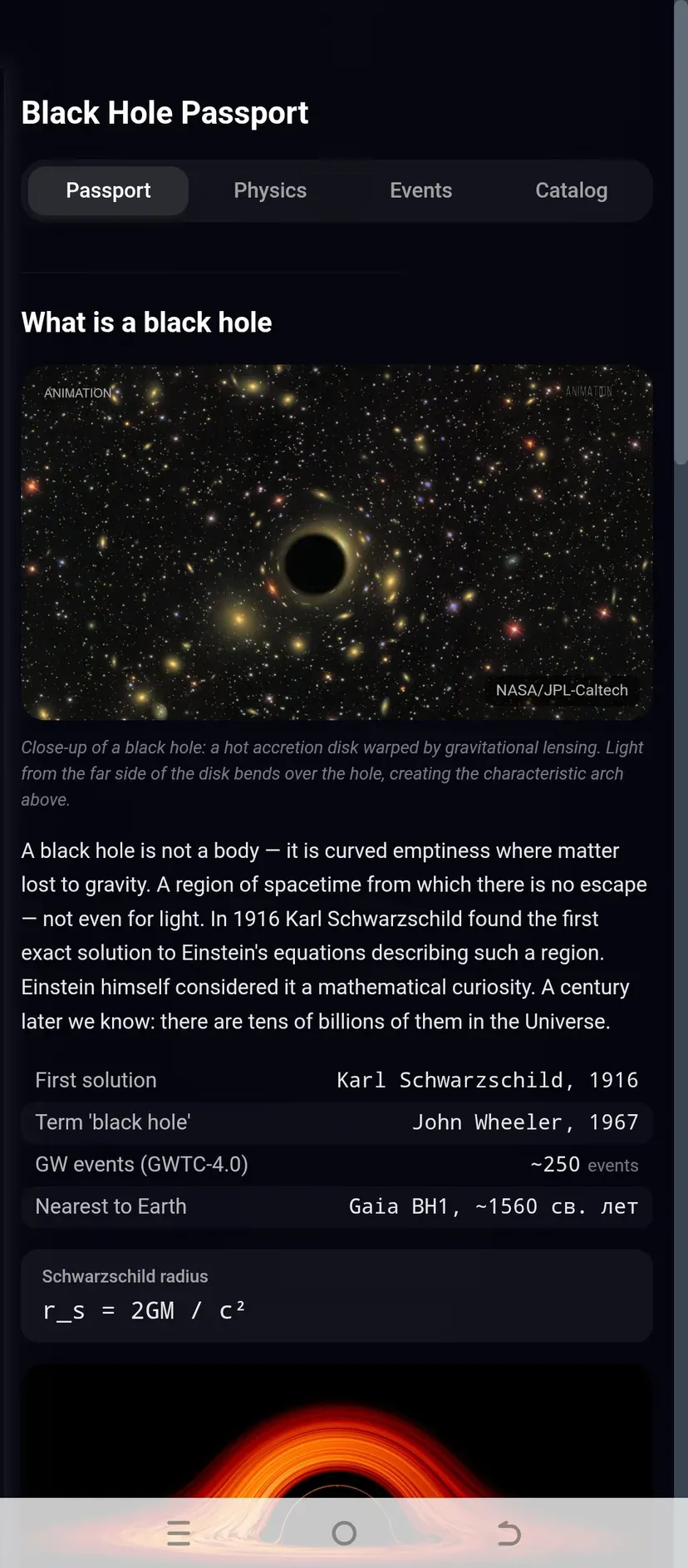
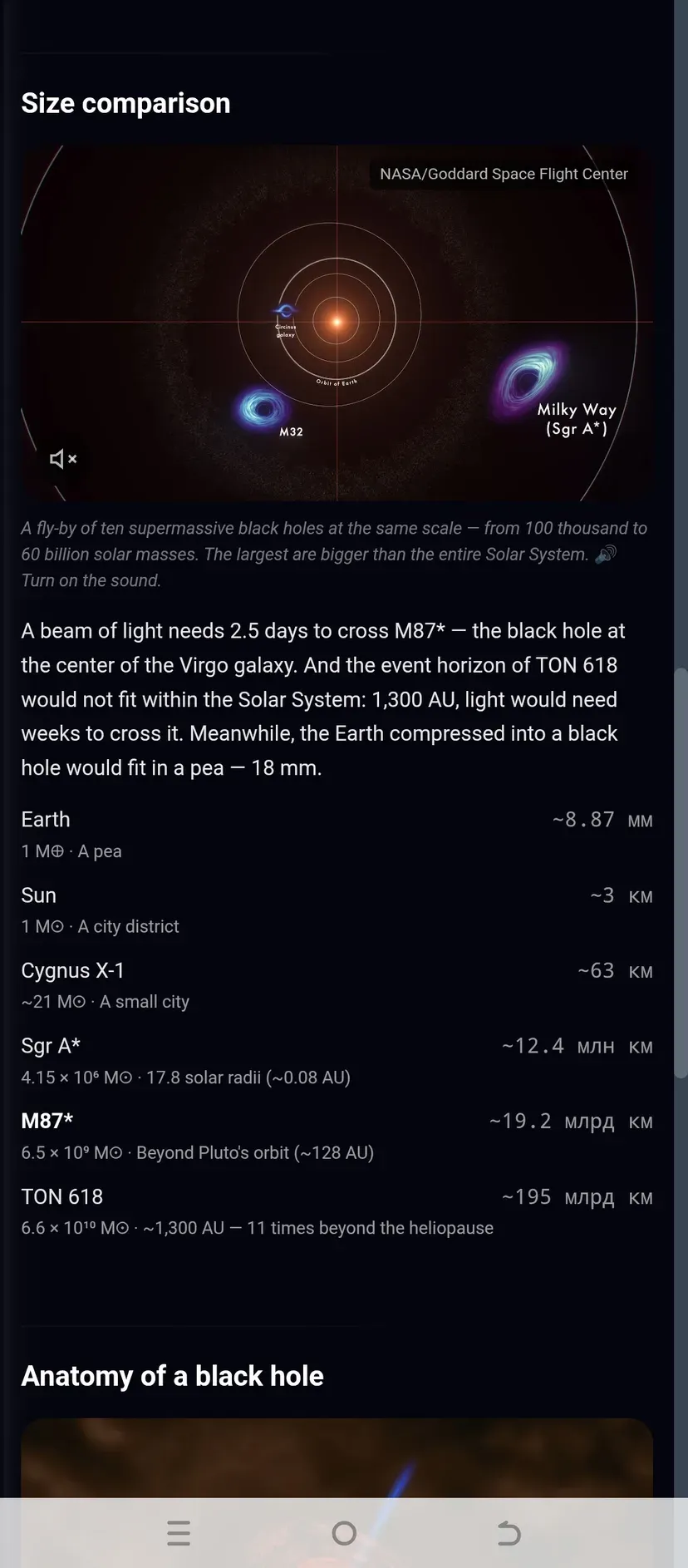
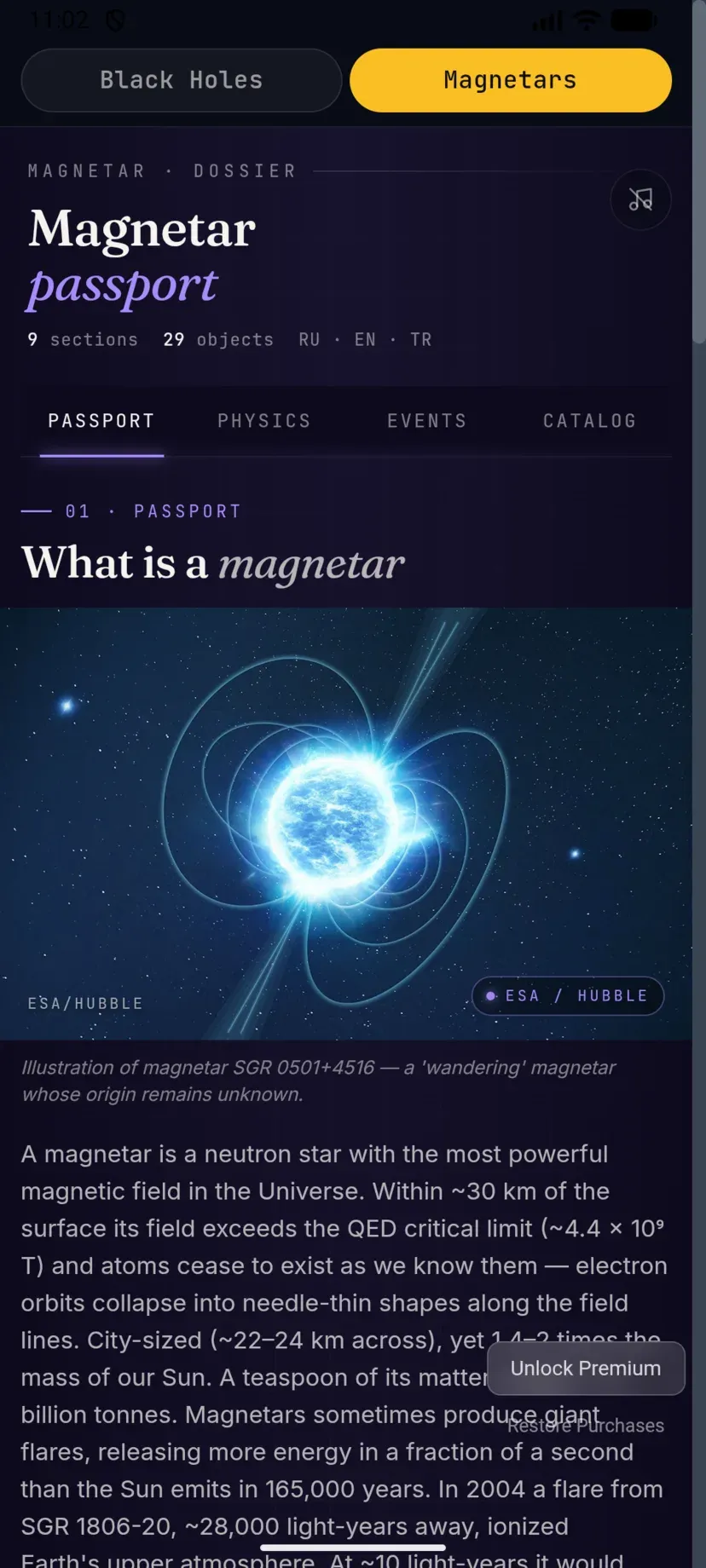
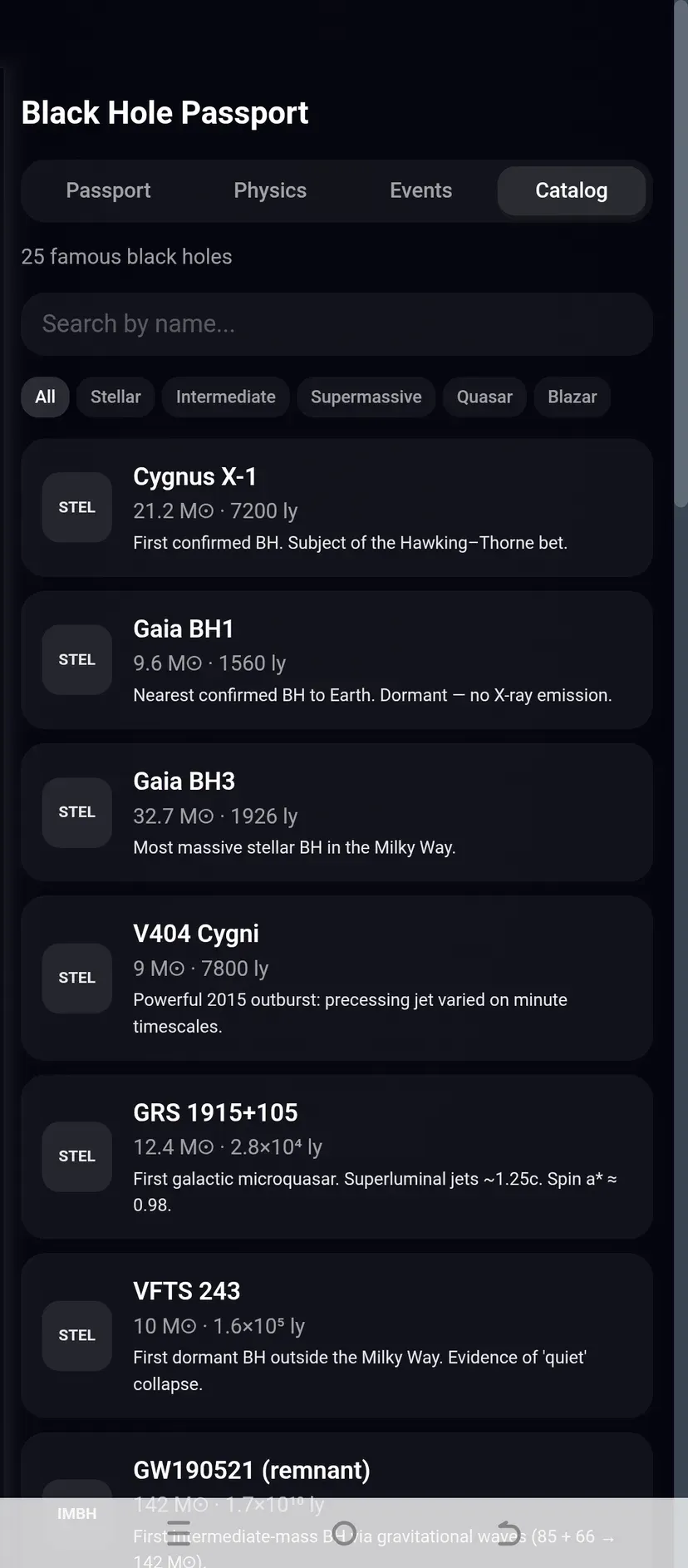
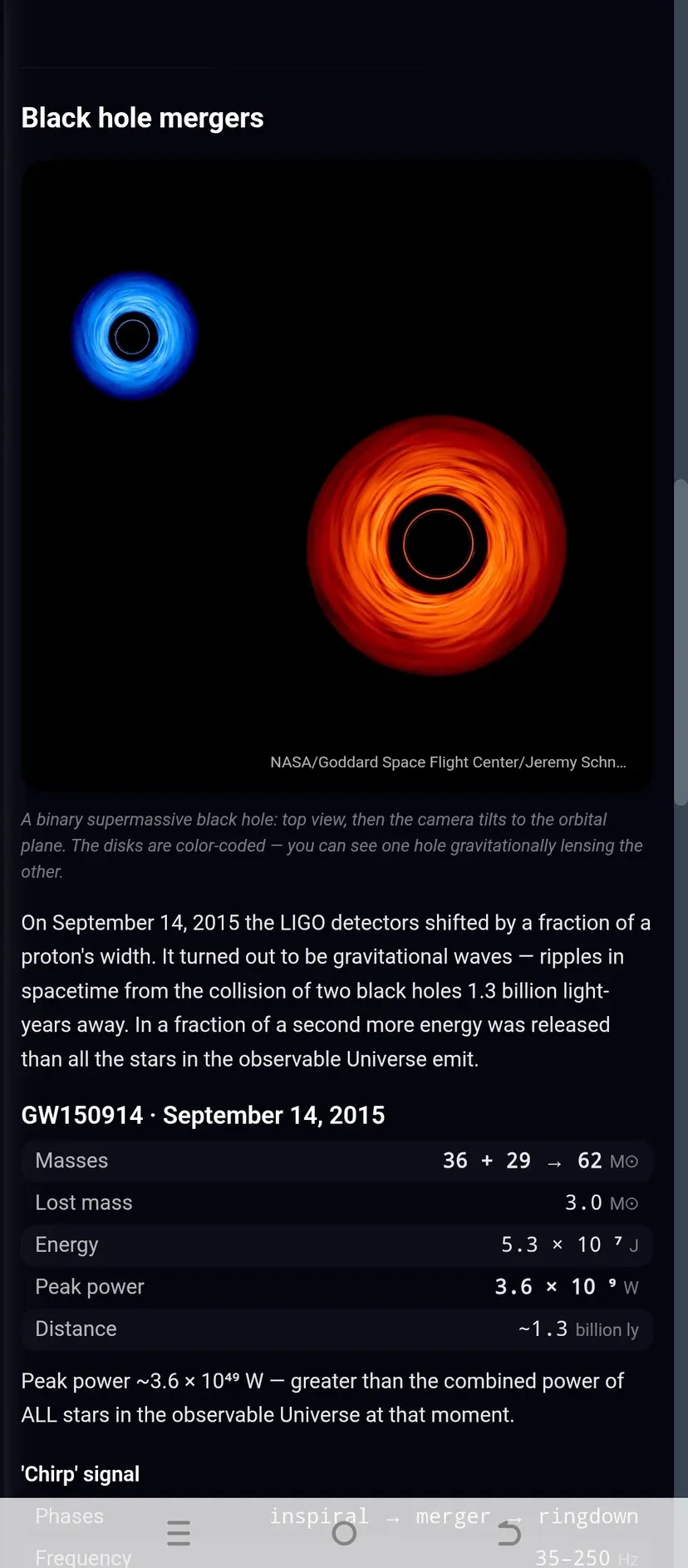
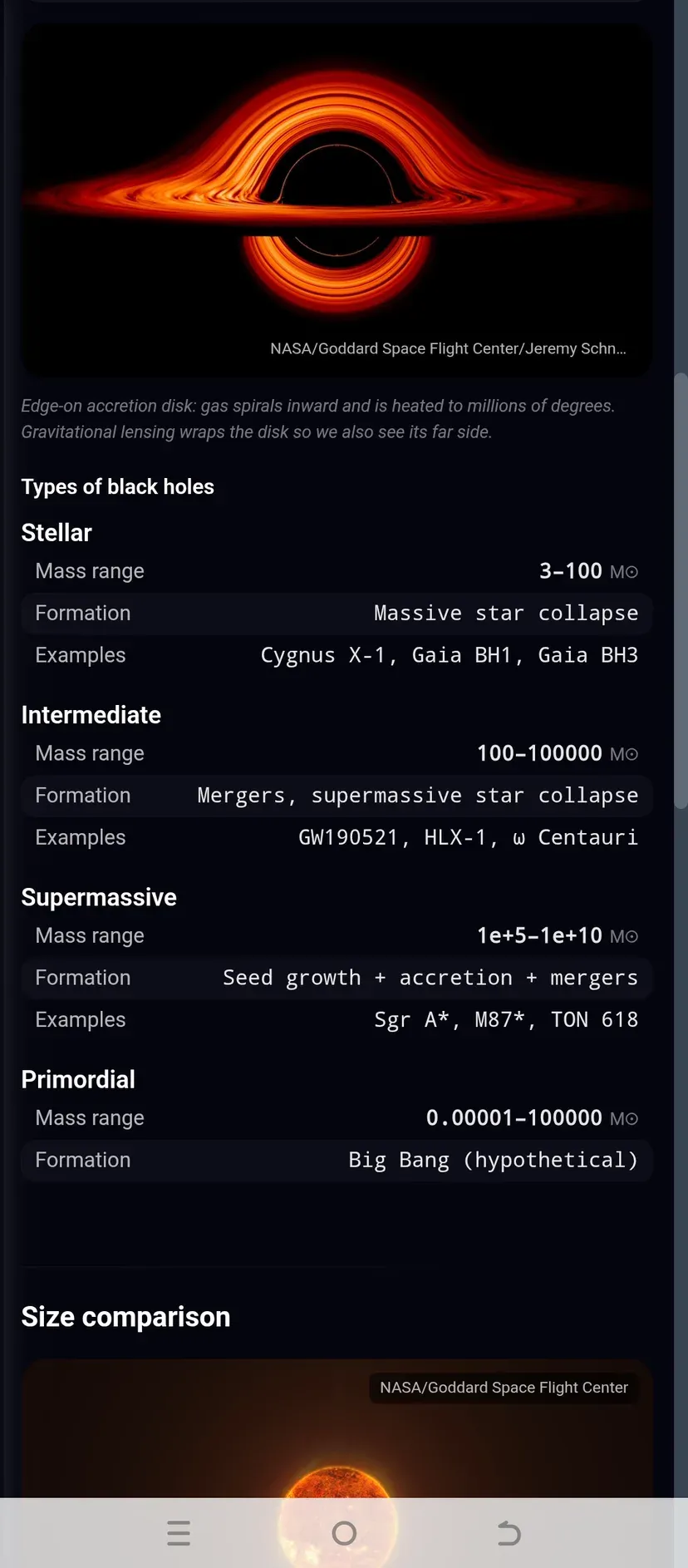
Two of the most extreme classes of object in one app, a single tap apart. The numbers here are not rounded into prettiness: they come from the Event Horizon Telescope, the LIGO/Virgo gravitational wave catalogues, Gaia astrometry and the McGill Magnetar Catalog.
Passport
What a black hole is and how spacetime curves around it. How much larger TON 618 is than the Solar System. What a magnetar is, and why its magnetic field is the strongest in the known Universe. Answered with clear visuals and precise numbers.
Catalogue
Twenty-five famous black holes and twenty-nine magnetars with real parameters: mass, distance, spin period, magnetic field, discovery method and confidence level. Cygnus X-1, Gaia BH1, Sgr A*, M87*, TON 618, 3C 273, SGR 1806-20 and the rest — from peer-reviewed publications.
Physics
Seven layers of a black hole’s anatomy, from relativistic jets to the ring singularity. Hawking radiation, the information paradox, gravitational lensing, time dilation and spaghettification. Separately, the structure of a neutron star: how a magnetar is born from a supernova, nuclear pasta, and starquakes that release more energy in a fraction of a second than the Sun does in thousands of years.
Events
The moments that made the field: the first image of M87* (EHT, 2019) and of Sgr A* (EHT, 2022), GW150914 — the first gravitational wave detection, the neutron star merger GW170817, the SGR 1806-20 giant flare, fast radio bursts and kilonovae.
Scientific visualisations
NASA and ESA animations rather than an artist’s impression: a star torn apart by tidal forces, the chirp of GW150914, a camera plunging through an event horizon, a kilonova born from a neutron star merger. Every clip names its source — NASA/Goddard, NASA Scientific Visualization Studio, ESA/Hubble, the EHT Collaboration.
Free and purchase
The passport and the catalogue are free in full. A single purchase, no subscription, opens Physics and Events — for black holes and magnetars at once.
No ads, no accounts, no sign-in. Works offline.