Epilogue
The Return
How contemplation ends
Where does contemplation lead?
لَا تَبْلُغُهُ الْأَوْهَامُ، وَلَا تُدْرِكُهُ الْأَفْهَامُ
Imaginings do not attain Him, and minds do not comprehend Him.
from the kalam
فَكُلُّ مَا تُخُيِّلَ فِي الْوَهْمِ أَوْ تُصُوِّرَ فِي الْفَهْمِ، فَاللَّهُ سُبْحَانَهُ وَتَعَالَى بِخِلَافِهِ
And all that has been pictured in imagination or formed in the mind — Allah, glorified and exalted, is other than it.
What we saw — and what it was
Behind us, fifteen halls. Space without a center and time without a common "now" spoke of the unlikeness of the Creator. A pattern that gathered with no path — of the discipline of not-knowing, . And there, from where not even light returns — of the Hidden, from whom nothing is hidden. The tremor of space learned to sound; fine-tuning showed the selection out of the possible; causality brought al-Ghazali and Hume face to face. We passed through the hall of the Living, the Hearing, the Seeing; the Speech of Allah and its carriers; the oneness to which the path is drawn; a world that might not have been; . And toward the end the path stepped beyond the world itself: the Hour, when all that is transient vanishes; the resurrection, in which the One who began brings back; and the beholding — the gaze upon the One the whole path was about. Not one hall proved a single line of the creed — nor did we ask it to. They did something else: they gave reason occasions to stop and contemplate.
The creed we walked with remained what it was: tenets of revelation and arguments of , standing on their own foundations. Science remained science — revisable, careful, magnificent. Between them is neither war nor identity, but a contemplative neighborhood: , the drawing of a lesson.
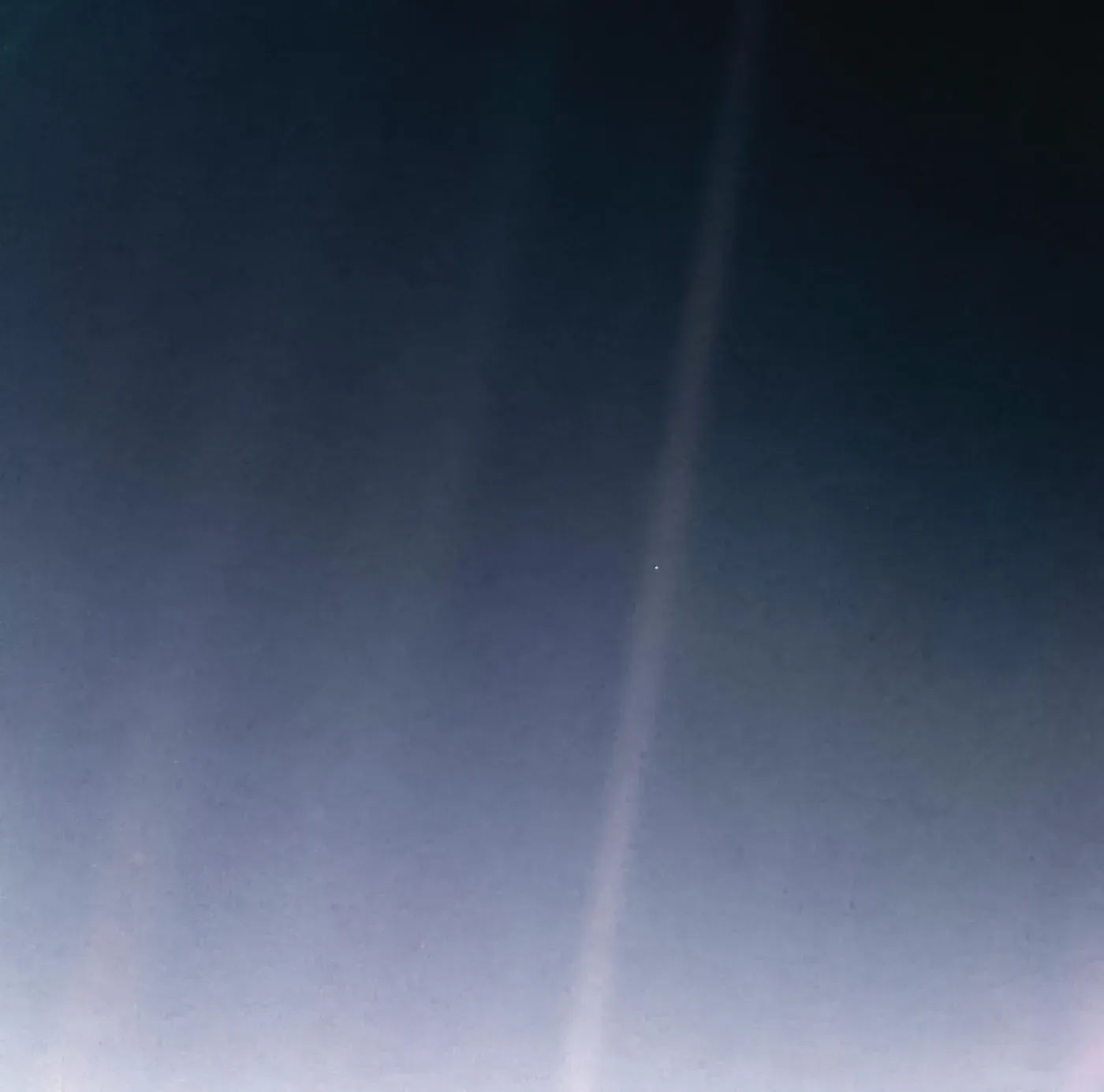
The pale blue dot
Earth from a distance of about six billion kilometers: a dot smaller than a pixel in a band of scattered sunlight. A Voyager 1 image, 14 February 1990 — among the last frames its cameras took. This same probe carries the golden record from the hall of Speech.
Smaller than a pixel — and on this dot stood everyone who ever looked up.
مَا السَّمَاوَاتُ السَّبْعُ فِي الْكُرْسِيِّ إِلَّا كَحَلْقَةٍ مُلْقَاةٍ بِأَرْضِ فَلَاةٍ، وَفَضْلُ الْعَرْشِ عَلَى الْكُرْسِيِّ كَفَضْلِ تِلْكَ الْفَلَاةِ عَلَى تِلْكَ الْحَلْقَةِ
The seven heavens beside the Kursi are no more than a ring cast down in an open desert. And the superiority of the 'Arsh over the Kursi is like the superiority of that desert over that ring.
A ring in the desert
The says it briefly: "the ' and the are true." What they are is entrusted to the One who knows: bila kayf, without a picture. But the tradition does name the measure: the seven heavens beside the Kursi are a ring cast down in a desert; and the Kursi itself is as small beside the 'Arsh. The transmission of this athar is contested by the scholars of hadith. We bring it as an image by which the tradition taught scale for centuries — not as a dogma.
Two frames: the dot in the beam — and the ring in the desert. Faith never lived in a small world. Long before telescopes the tradition already taught one to see the visible sky as a little ring lost in the sands: "the creation of the heavens and the earth is greater than the creation of mankind". So the scientific scale does not crowd the one who contemplates — it returns to him an old sense of measure. But the Kursi and the 'Arsh are of the unseen world: they are not plotted on the maps of cosmology, and the "seven heavens" are not the observable Universe.
الَّذِينَ يَذْكُرُونَ اللَّهَ قِيَامًا وَقُعُودًا وَعَلَىٰ جُنُوبِهِمْ وَيَتَفَكَّرُونَ فِي خَلْقِ السَّمَاوَاتِ وَالْأَرْضِ رَبَّنَا مَا خَلَقْتَ هَٰذَا بَاطِلًا سُبْحَانَكَ
…who remember Allah standing and sitting and on their sides, and reflect on the creation of the heavens and the earth: "Our Lord, You did not create this in vain. Glory be to You!"
from the kalam
قَوْلُهُ تَعَالَى: ﴿يَذْكُرُونَ اللَّهَ﴾ إِشَارَةٌ إِلَى عُبُودِيَّةِ اللِّسَانِ، وَقَوْلُهُ: ﴿قِيَامًا وَقُعُودًا وَعَلَى جُنُوبِهِمْ﴾ إِشَارَةٌ إِلَى عُبُودِيَّةِ الْجَوَارِحِ وَالْأَعْضَاءِ، وَقَوْلُهُ: ﴿وَيَتَفَكَّرُونَ فِي خَلْقِ السَّمَاوَاتِ وَالْأَرْضِ﴾ إِشَارَةٌ إِلَى عُبُودِيَّةِ الْقَلْبِ وَالْفِكْرِ وَالرُّوحِ
The Exalted's words "remember Allah" point to the servitude of the tongue; "standing, sitting and on their sides" point to the servitude of the body and its limbs; "and reflect on the creation of the heavens and the earth" point to the servitude of the heart, thought and spirit.
The end of the halls is not the end of contemplation
The exposition has ended; has not. The same stars this whole path spoke of stand above you every night — now without captions. If this path taught anything, it taught a single skill: to see the world as a sign — and to say no more about its Creator than we have been given to know.
And one last thing, for the attentive. The path you walked is not a list of themes but a map of attributes. Space and Time spoke of the unlikeness of the Creator — . The Quantum World — of how to speak of the attributes at all, bila kayf. Knowledge, Will, Power, the Living-Hearing-Seeing and Speech — these are sifat, attributes of the Essence. Oneness gathered them in the One. Being led to the Necessary, Qadar — to measure and to the record. And the last halls stepped over the threshold of the world — into the section of the last life: the end, the resurrection, the beholding — and so closed the path upon Allah, upon the gaze toward Him. The later school drew the attributes into such a map, and the three judgments of reason with which the Prologue began are its key; Imam al-Sanusi cast them in the "Umm al-Barahin". Should you wish to return — walk now by the map itself, hall by hall.