Prologue
Two Readings
Two books of signs: revelation and creation
What do a verse of the Qur'an and the starry sky have in common?
إِنَّ فِي خَلْقِ السَّمَاوَاتِ وَالْأَرْضِ وَاخْتِلَافِ اللَّيْلِ وَالنَّهَارِ لَآيَاتٍ لِّأُولِي الْأَلْبَابِ
Indeed, in the creation of the heavens and the earth and in the alternation of night and day are signs for people of understanding.
An is a sign
The Qur'an uses the word "ayah" both for its own verse and for a phenomenon of nature: sunrise, rain, the turning of night and day. In the Islamic tradition, creation is a second book of signs. It is not read instead of revelation — it is contemplated alongside it. This kind of contemplation has a name: , reflection.
The material for tafakkur here is the modern picture of the Universe: cosmology and physics. It was described within the last century; the creed it will stand beside was set down more than a thousand years ago.
from the kalam
وَلَا يَخْفَى أَنَّ الْفِكْرَ هُوَ مِفْتَاحُ الْأَنْوَارِ وَمَبْدَأُ الِاسْتِبْصَارِ، وَهُوَ شَبَكَةُ الْعُلُومِ وَمِصْيَدَةُ الْمَعَارِفِ وَالْفُهُومِ
It is no secret that reflection is the key to illuminations and the beginning of insight; it is the net of the sciences, the snare of knowledge and understanding.
Contemplation is not proof
Faith and knowledge stand on different foundations. Besides, the picture of the world is not final — what is firm today, science will refine tomorrow. We look at it for the sake of : the lesson the contemplative draws.
The creed stands on its own foundations — on revelation and on the arguments of , the rational theology of Islam; that is why faith is set out here before science and apart from it. And where faith and science are set side by side as a contemplative likeness rather than as a proof, it is marked as such.
What it is about — and what it is not
The tradition divides the creed into three great parts: on Allah — kalam calls it the Ilahiyyat — on prophethood, and on the last life. This path goes through two of the three — there where creation gives an occasion for contemplation: most of the way is about the attributes of the Creator, and toward the end it comes out to the fate of the world — its end, the resurrection and the meeting. The spine is the attributes of God: nearly every hall stands on one of them, and everything orbits the One, ; the full hall of oneness waits nearer the end.
The second arc — prophethood — we deliberately pass by: its proofs lie in text, history and language — the preservation of the Qur'an, the life of the Prophet, his message — not in a contemplation of the cosmos. Within Ilahiyyat and Sam'iyyat a scientific exhibit appears only where the pairing needs no stretch; some attributes have none at all. This is a contemplative neighborhood along the attributes that creation lights up — not a full catechism.
The creed here is set out as the Ash'ari–Maturidi school of Ahl al-Sunna reads it. , the uncreatedness of the Qur'an, are given as common-Sunni tenets.
تَفَكَّرُوا فِي خَلْقِ اللَّهِ وَلَا تَتَفَكَّرُوا فِي اللَّهِ
Reflect on the creation of Allah — and do not reflect on Allah Himself.
Intra-Sunni seam
Does reason obligate — before revelation?
This very move — from creation to the Creator — is itself a matter of dispute between the two schools of Sunni kalam: the Ash'aris and the Maturidis. The Maturidis hold: reason itself obligates a person to know the Creator — even before revelation arrives. The Ash'aris reply: obligation is established only by revelation. Reason is an instrument of knowing, not a legislator. Both positions lie within Ahl as-Sunna.
from the kalam
اعْلَمْ أَنَّ الْحُكْمَ الْعَقْلِيَّ يَنْحَصِرُ فِي ثَلَاثَةِ أَقْسَامٍ: الْوُجُوبِ وَالاِسْتِحَالَةِ وَالْجَوَازِ. فَالْوَاجِبُ مَا لَا يُتَصَوَّرُ فِي الْعَقْلِ عَدَمُهُ، وَالْمُسْتَحِيلُ مَا لَا يُتَصَوَّرُ فِي الْعَقْلِ وُجُودُهُ، وَالْجَائِزُ مَا يَصِحُّ فِي الْعَقْلِ وُجُودُهُ وَعَدَمُهُ
Know: the judgment of reason is confined to three divisions — the necessary, the impossible and the possible. The necessary is that whose non-existence reason cannot conceive; the impossible is that whose existence reason cannot conceive; the possible is that whose existence and non-existence reason admits equally.
The world is possible — the Creator necessary
The whole created world is of the possible kind: it could have been, it could have not been. And the possible does not explain itself — which means there is a Being of another order: the Necessary, , whose existence is borrowed from no one.
And this is the One whose attributes will be spoken of. The full argument — — we will unfold at the end of the path, in the hall of the Necessary Being: the arc will lead from the unlikeness of the Creator inward, to the deepest question — "why is there anything at all, rather than nothing". For now this is enough: the attributes that will light the halls are attributes of the established Necessary Existent, not guesses about the unknown.
The conflict that never was
The familiar picture of an "eternal war between science and religion" was born in 19th-century polemics — with Draper and White. Historians of science long ago took apart its key episodes: they do not survive scrutiny. Nor does the myth that "al-Ghazali killed Islamic science". Astronomy and mathematics flourished in the Islamic world for centuries after him — the historian George Saliba showed this through observatories and planetary models.
This history is part of the ummah's heritage: the observatories of Maragha and Samarkand, the optics of Ibn al-Haytham, the algebra of al-Khwarizmi. Contemplating the sky and exact knowledge walked hand in hand in the Islamic world for centuries.
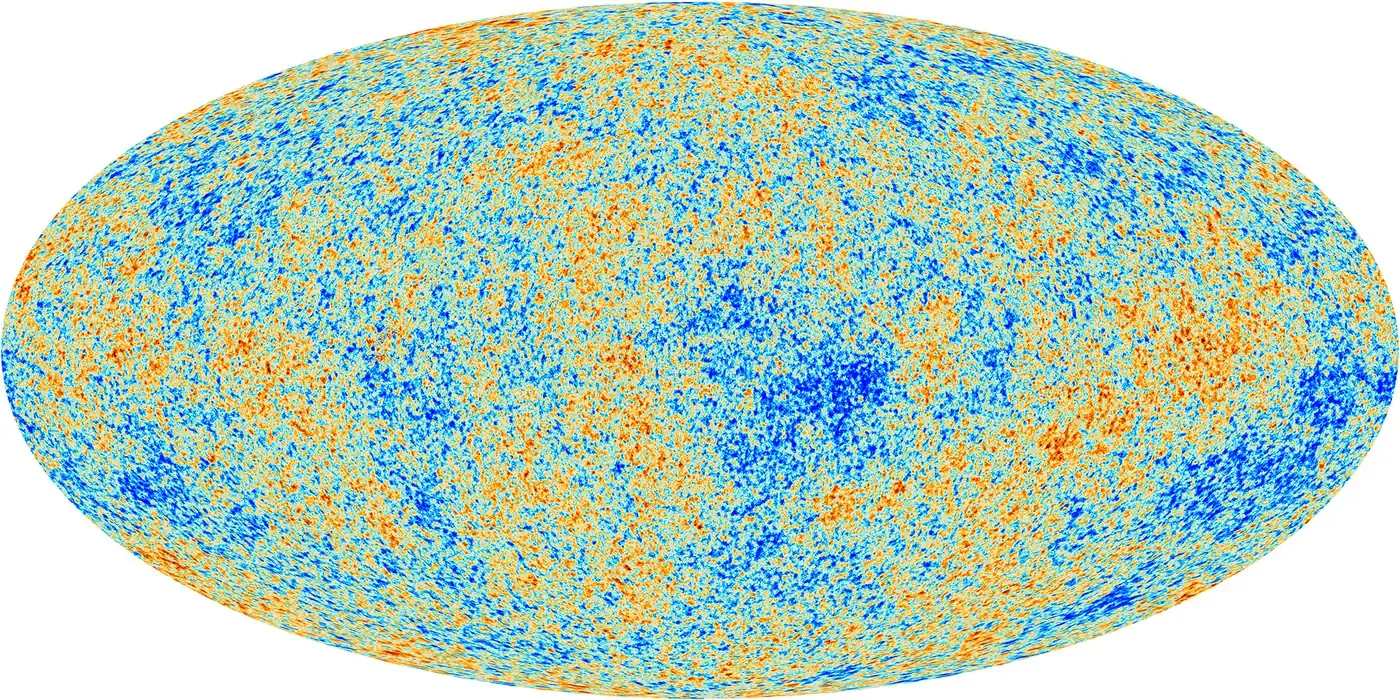
The wall of last scattering
This is the oldest light we can observe — a portrait of the Universe at the moment it first became transparent. It has been traveling toward us for about 13.8 billion years; it set out when only 380,000 years had passed since the beginning. Before that the cosmos was a scorching, impenetrable plasma — light bogged down in it, not flying even a single step. Whichever way you point a telescope, the ray runs into the same wall: no instrument will see deeper by light — beyond it the Universe is closed to light.
The boundary of the observable is not the boundary of what exists.