Qadar · measure and the record
Predestination: to know is not to compel
Written — therefore compelled?
وَأَصْلُ الْقَدَرِ سِرُّ اللهِ تَعَالَى فِي خَلْقِهِ، لَمْ يَطَّلِعْ عَلَى ذَلِكَ مَلَكٌ مُقَرَّبٌ وَلَا نَبِيٌّ مُرْسَلٌ
The root of qadar is the secret of Allah Most High in His creation: no angel drawn near and no prophet sent has been given access to it.
Knowledge, writing, will, creation
Faith in predestination — qadar — is named in the Hadith of Jibril among the pillars of iman: to believe "in predestination, its good and its evil". The unfolds it in four words. Allah knows all things — before things exist, not as events unfold. He wrote — "in the Tablet and the Pen". Everything flows by His will. And everything that exists is His creation. Knowledge, writing, will, creation: the creed here is whole and calm.
But precisely here faith meets the most personal question: if everything is already known and written, do I choose anything at all? Here everything is built differently from the previous science stops of the path: there is no chief scientific exhibit. Foreknowledge has no physical double, and qadar is not fastened to equations. Science appears in one modest role — to give an image for a distinction had articulated long before it. We begin with that distinction: to know is not to force.
وَنُؤْمِنُ بِاللَّوْحِ وَالْقَلَمِ وَبِجَمِيعِ مَا فِيهِ قَدْ رُقِمَ، فَلَوِ اجْتَمَعَ الْخَلْقُ كُلُّهُمْ عَلَى شَيْءٍ كَتَبَهُ اللهُ تَعَالَى فِيهِ أَنَّهُ كَائِنٌ، لِيَجْعَلُوهُ غَيْرَ كَائِنٍ، لَمْ يَقْدِرُوا عَلَيْهِ
We believe in the Tablet and the Pen, and in all that has been inscribed therein. If all created beings gathered against something Allah Most High had written there as coming to be — to make it not come to be — they would not be able.
A record is not a cause
An astronomer calculates eclipses centuries ahead: the table lies in a book, and at the appointed hour the shadow really crosses the Moon. But the Moon does not darken because the table commanded it — the table is true because the eclipse will occur. Knowledge conforms to its object; it does not produce it. What compels is power, not awareness. Later kalam cast this in a short formula: knowledge follows the known. Not follows in time — Allah's knowledge is pre-eternal and does not "learn" as events unfold — but follows in the very meaning of the word "to know": true knowledge is as its object is.
The same distinction reads the Tablet. Al-Lawh al-Mahfuz is the record of the One who knows, not a program: the world does not "execute" it as a machine executes code, and it does not push events forward — it is truthful about them. The matn's line about created beings being powerless to cancel what is written is about the perfection of Allah's knowledge and His omnipotence — not about the servant's act ceasing to be his act. Whose act it is remains a separate, finer question; the tradition answers it with the word .
Laplace's demon
Modern physics invented its own image of a future completely known — not a record, but a calculation. In 1814 Pierre-Simon Laplace described an intellect given the positions and velocities of all particles in the world and all the forces acting on them: for such an intellect, "nothing would be uncertain, and the future, like the past, would be present before its eyes". The image was called Laplace's demon, and the picture, determinism: the present contains the future as premises contain a conclusion, and the laws draw it out without remainder.
How unlike this is to the Tablet is clear at once: for Laplace the future is derived from the present by the force of laws, and the demon's "knowledge" is simply a very long calculation; the Tablet is neither initial conditions nor an equation of evolution, but the record of the One who knows not by inference and not in parts. More important still: determinism is a property of models, not a verdict of science. Classical mechanics is deterministic; in quantum theory everything depends on interpretation — in the Copenhagen picture outcomes are probabilistic, while in Bohm and Everett there is no randomness at all, and experiment, as we saw in the hall of the Quantum World, does not choose between them. Physics has issued no certificate saying whether the world is deterministic or not — and promises none.
The Lyapunov horizon
And within deterministic physics itself something appeared that Laplace did not foresee. There are systems — a double pendulum, three attracting bodies, Earth's atmosphere — where the equations are simple and unambiguous, while prediction is rapidly exhausted. The meteorologist Edward Lorenz came upon this in 1961 almost casually: restarting a calculation, he entered a rounded number — 0.506 instead of 0.506127 — and after several "model weeks" the machine's weather had nothing in common with the first run. A tiny error in knowledge of the present grows exponentially; the characteristic time of that growth is called the Lyapunov time, and beyond its horizon prediction loses force. For Earth's weather the horizon is on the order of two weeks, and supercomputers do not move it away: every gained day requires multiplying the precision of initial data again and again.
The lesson is often retold imprecisely. "A butterfly causes a hurricane" — no: a butterfly's wing is not the force that moves cyclones. The precise lesson is drier and deeper: in deterministic chaos the future is fully determined by the present — and at the same time in principle inaccessible to finite knowledge; to look farther, one would need to know the present more precisely than any attainable precision. "Determined" and "predictable for us" turned out to be different properties: the first concerns things themselves, the second the limits of the knower. Physics learned this distinction from its own equations. Remember it — we will need it now.
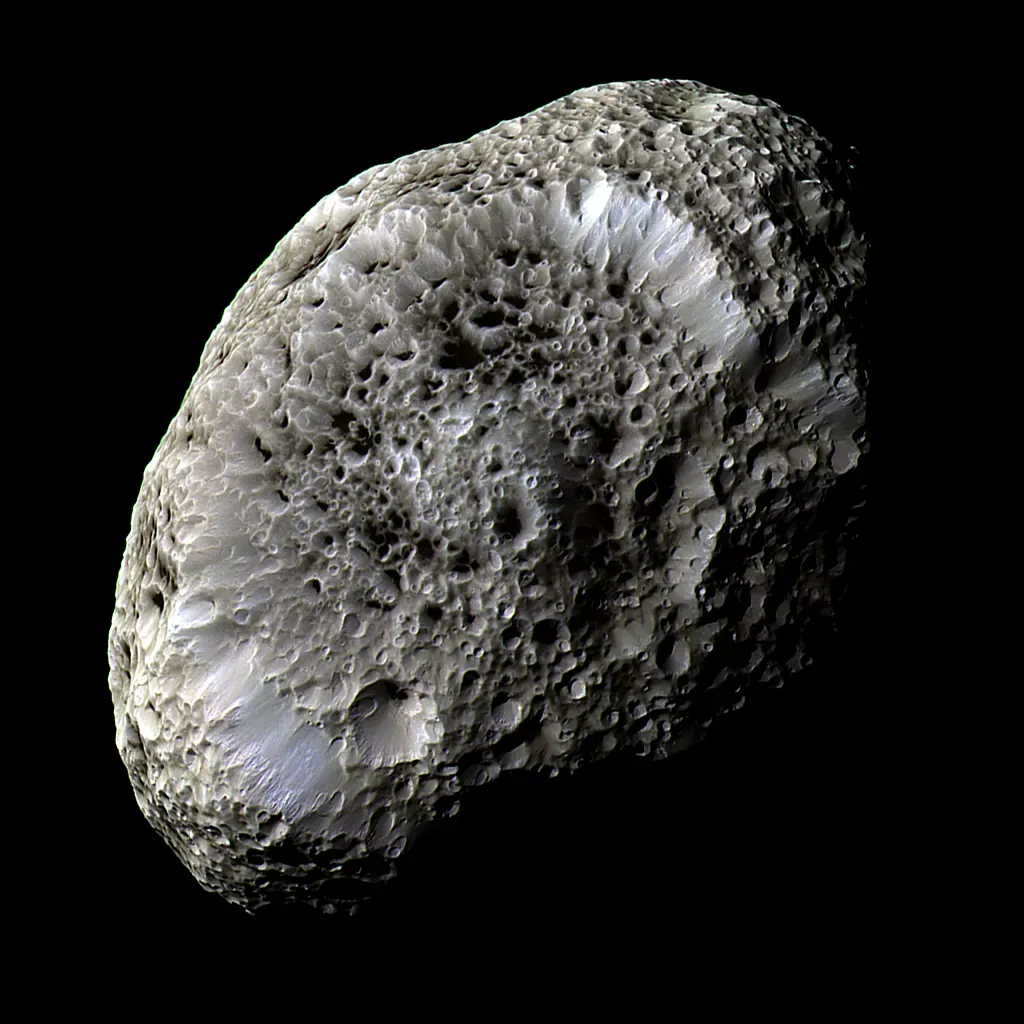
The tumbling moon
Hyperion, a moon of Saturn, in Cassini's camera: a porous, sponge-like body about 270 kilometers across (false colour, tones enhanced). It was the first body in the Solar System whose chaotic rotation was observed: Hyperion tumbles with no fixed axis or period, and no one can calculate how it will be oriented several months from now — though only the gravity of Saturn and Titan moves it.
The equations of its motion are simple; the future in them is determined — and inaccessible to any calculator.
Determined is not accessible
To this meeting the whole path led. The physics of chaos distinguished this: a fact may be fully determined — and unreadable to finite knowledge; tomorrow's state of the atmosphere is "already contained" in today's, yet no attainable precision reaches it. Kalam has held its own distinction for a thousand years: qadar is determined and written — and hidden from the creature. "The secret of Allah in His creation", into which, according to the matn, neither an angel drawn near nor a prophet sent is admitted: the Tablet is not handed over to be read. Man is not given the record to read — he is given action.
And the limit — it is very near. Exactly one structural feature coincides: "determined" does not mean "accessible to one inside it". Beyond that the paths part completely: in chaos there is no knowledge, no will, no responsibility — only dynamics and the finite precision of those who measure; qadar is about Allah's knowledge, will and creation, and about the servant's responsibility, and it is determined not by initial conditions but by the One who knows. Chaos is not a model of qadar and still less a model of kasb; it merely taught physics itself not to confuse "determined" with "predictable" — and by doing so made an ancient distinction of kalam unexpectedly audible to a modern ear.
وَأَفْعَالُ الْعِبَادِ خَلْقُ اللهِ وَكَسْبٌ مِنَ الْعِبَادِ
The acts of the servants are Allah's creation and the servants' acquisition (kasb).
Intra-Sunni seam
Whose act?
The matn's line about the acts of servants is double: the act is created by Allah and acquired by the servant. How exactly to read "acquisition" — kasb — is an intra-Sunni seam, and we name it by school. The Ash'ari line protects omnipotence: created power has no independent efficacy — no ta'thir; Allah creates the act, the capacity for it, and their conjunction, while the act is imputed to the servant because it is created at his intention and power. Al-Baqillani softened this strictness from within the school: he allowed the servant's efficacy — but not over the being of the act, rather over its "aspect": over what the act is, obedience or disobedience. The Maturidi line speaks more firmly of choice: the servant's is real; Allah grants him a created capacity — — and creates the act that the servant truly chose. The choice is the servant's; the creation is Allah's.
What the schools share matters more than what divides them — and it is two-sided. Both reject : man is not a leaf in the wind, and the act does not cease to be his act; otherwise command, prohibition and Judgment lose their meaning. And both reject the opposite extreme — "man is the creator of his own acts", removing the act from Allah's creation. The middle formula holds both together, as the Qur'an holds them: "for it is what it acquired, and against it is what it acquired".
from the kalam
وَلِلْعِبَادِ أَفْعَالٌ اخْتِيَارِيَّةٌ يُثَابُونَ بِهَا وَيُعَاقَبُونَ عَلَيْهَا
The servants have voluntary acts for which they are rewarded and for which they are punished.
لِمَن شَاءَ مِنكُمْ أَن يَسْتَقِيمَ، وَمَا تَشَاءُونَ إِلَّا أَن يَشَاءَ اللَّهُ رَبُّ الْعَالَمِينَ
…for whoever among you wills to go straight. But you do not will unless Allah wills, the Lord of the worlds.
Qadar is not physical determinism, and "science has proved there is no choice" is as much metaphysics as its opposite; in equations there is no one who acts. The hall's final word belongs to the matn with which it began: the root of qadar is a secret. Beyond the line where Revelation and argument end, conjecture begins — and the practice of faith stands on this side of the line: in what is not in your hands, ; in what is in your hands, the act for which you are accountable. The written record is not read by the creature. But hands were given to him — and they will be asked about.