Imkan · the argument from the possible
The Necessary Being
: a world that might not have been
Why is there something at all, rather than nothing?
حَيٌّ لَا يَمُوتُ، قَيُّومٌ لَا يَنَامُ
The Living who does not die; the Self-Subsisting who does not sleep.
from the kalam
نَفْيُ النَّوْمِ مِنْ لَوَازِمِ كَوْنِهِ قَيُّومًا، لِأَنَّ جَمِيعَ الْأَشْيَاءِ قَائِمٌ بِهِ، فَلَوْ يَعْتَرِيهِ النَّوْمُ لَفَسَدَ نِظَامُ الْعَالَمِ
The negation of sleep follows from His being al-Qayyum: all things subsist through Him. Were sleep to overtake Him, the order of the world would fall apart.
The One who holds all
Al-Hayy, the Living; al-Qayyum, the Self-Subsisting — He who stands of Himself and holds everything else. The adds: He "has no need of the Throne and what is beneath it" — that is, of anything created at all. The creed draws here the deepest line there is: on one side, He whose being is borrowed from no one; on the other, everything else, existing not of itself — the world receives being, is held in it, and might not have been.
This is no tale of a distant beginning. "Qayyum" is a present-tense word: the world is held now, as a note is held while it is being sung. So the question here is not "what came first of all?" but another, stranger and deeper one: why is there something rather than nothing? Why does the world exist — right now?
قُلْ هُوَ اللَّهُ أَحَدٌ، اللَّهُ الصَّمَدُ
Say: "He is Allah, the One; Allah, as-Samad — the Self-Sufficient, whom all things need."
The argument from the possible
cast this question into an argument — imkan, the argument from possibility. Everything in the world — and the world as a whole — is mumkin, possible: its being and its non-being are equally thinkable, and nothing in its own essence tips the scale toward "to be". But the possible does not tip its own scale: since it exists, its being is given from elsewhere. And a chain of possibles lending being to one another does not explain itself, however long it is made — as mirrors reflecting light do not explain the light. There must be a Being of another order — the Necessary, : its being is not borrowed but its own; it is the source of every "is".
This move came into kalam from falsafa: Ibn Sina minted it; kalam first argued with it through al-Ghazali — and then, from al-Razi on, took the argument into its arsenal beside . It is not in al-Tahawi's matn — a late-kalam argument, not a line of the creed. This argument has two properties for which the whole discussion is built around it. Imkan is not about probability: it needs no measure and no "odds" — only the difference between the possible and the necessary. And it is not about a beginning in time: even a beginningless world would still be possible — and would still need the Necessary. The argument holds the world now, not merely "back then".
Intra-Sunni seam
Two roads to the Necessary
Within the tradition two roads lead to the Necessary, and they do not coincide. Early kalam of both schools walked the road of hudus: whatever has come to be requires One who brought it to be — the world began, hence there is a Beginner; al-Maturidi himself walked this road. Later kalam — from al-Razi on — added imkan: a road not from beginning but from possibility itself; it does not need the question of whether the world began. The roads are built differently and are vulnerable differently — the tradition kept both without merging them.
and imkan are twins that are not to be added into one: they answer different questions. Takhsis: why, of equally possible configurations, was this one realised? — and it leads to a Chooser, through will. Imkan: why is there anything possible at all, rather than nothing? — and it leads to the Necessary, through being itself. To add them into "one big argument" would be to count one thing twice; to keep them side by side is to watch two different questions meet in one Answer.
"From nothing" — from what?
With the science comes the main misunderstanding. Physics can speak of "vacuum", and that vacuum is not nothing. The quantum vacuum is the fields in their quietest state: it fluctuates, it presses plates together (the Casimir effect has been measured), it carries an energy cosmologists argue about. When a popular book promises "a universe from nothing" — from a quantum fluctuation — the word "nothing" there means: fields, laws, a space of possibilities. The philosopher David Albert answered one such book, by Lawrence Krauss, simply: fields are not nothing; the question "where do the fields and the laws themselves come from?" is left untouched.
The overclaim here cuts both ways. The atheist one: "science has explained how something arose from nothing" — no: it would have explained how one something is born of another something. And the Muslim one: "the quantum fluctuation just is 'Be!'" — also no: to nail Kun to one contested model is to let the eternal fall with the fashion. Physics here is neither for faith nor against it — it simply works on a different floor from the one where the question stands.
The question that remains
Suppose physics reaches its end — a final theory deriving everything from one line of equations. A question will remain that the theory itself cannot close: why is that line — enacted? Equations describe the world, but description does not bring the described into being: Maxwell's equations light no lamp. Stephen Hawking ended his most famous book on precisely this puzzlement: what is it that breathes fire into the equations and makes a universe for them to describe?
This is Leibniz's question — "why is there something rather than nothing?" — the oldest question of metaphysics, and science does not retire it; it sharpens it: the better the world is described, the cleaner the question rings — why is it there at all? Physics leaves this question open and does not claim it. On that open ground kalam sets its argument — imkan.
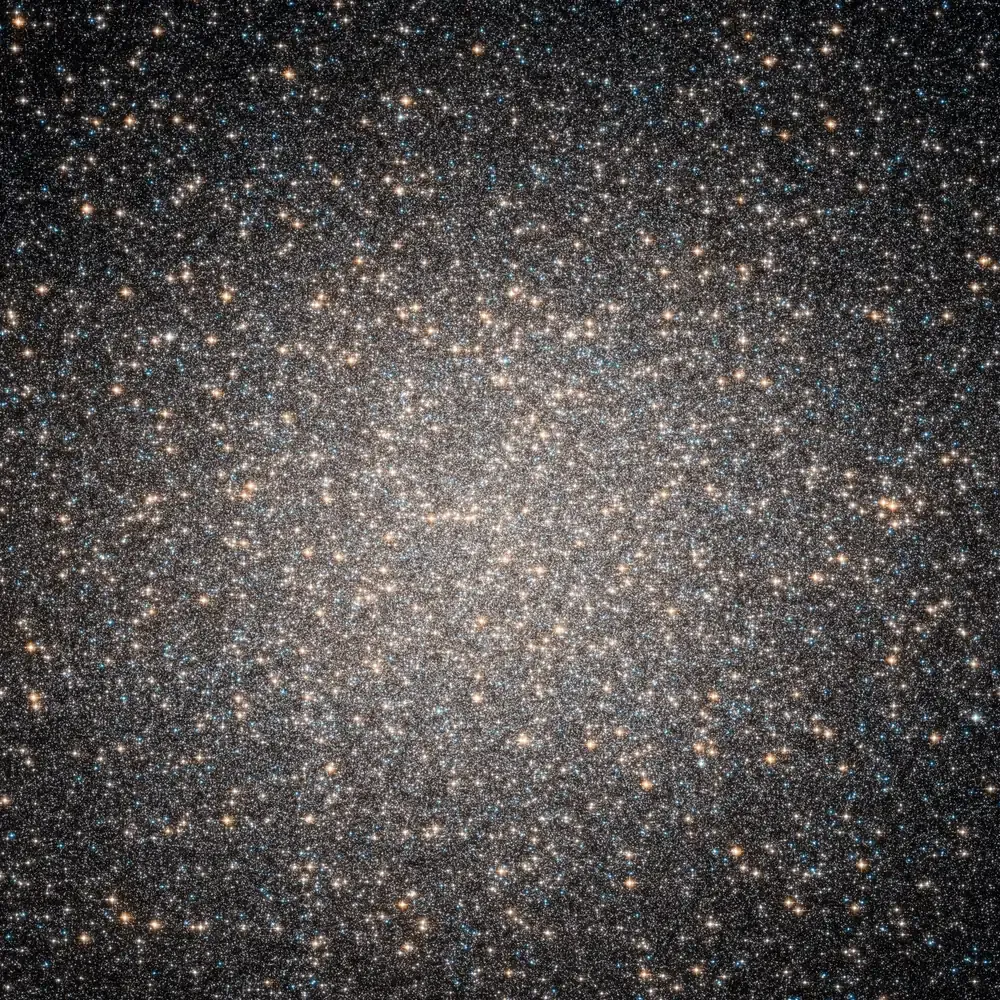
Ten million suns
Omega Centauri, the largest globular cluster of the Milky Way: a swarm of some ten million stars, 17,000 light-years away; many are older than ten billion years. Hubble's frame holds the heart of the swarm.
However many stars fit in the frame — it is a number. Vast is not infinite; infinity cannot be photographed.
One astonishment — two languages
The physicist, reaching the edge of the discipline, runs into "why is there something?" — and an honest physicist admits: not my floor. Kalam has called the world mumkin for a thousand years — possible, not obliged to be; and the Qur'an calls man faqir — poor toward Allah, and kalam reads that poverty ontologically: as a need for being itself. The astonishment is one — "the world does not explain itself" — but the disciplines differ: one stops before the question, the other answers it with an argument and with Revelation.
Imkan is not about holes at all: it would work just as well in a world where physics is finished and every equation balances. The possible's need of the Necessary is not a gap in knowledge but the structure of being itself, as kalam reads it. Here is only a consonance of two languages about one astonishment; the argument itself stayed a floor above.
Coda: infinity
A theme is often pinned to this hall: "an eternal world is impossible, because actual infinity is impossible." Mathematics after Cantor works calmly with infinite sets: transfinite arithmetic is consistent, and Hilbert's hotel is not a contradiction but an unfamiliarity. It is also true that the consistency of a concept is not the same as its realisability in the world: whether an infinite past can be traversed step by step, philosophers dispute to this day. The dispute is open; faith does not need it: hudus stands on Revelation and its own arguments, and imkan is not about time at all.
And Cantor himself left this coda an unexpected gift. The creator of the theory of the infinite distinguished the transfinite — the infinities mathematics counts and compares — from the Absolute, which he set above them. The transfinite he gave to mathematics; the Absolute he referred to God — it can be acknowledged, he wrote, but never comprehended. The man who taught humanity to count infinities drew, with his own hand, the line the tradition calls : what is beyond all measure is not measured. It is no more than a kinship — but to walk past it in silence would be waste.
يَا أَيُّهَا النَّاسُ أَنتُمُ الْفُقَرَاءُ إِلَى اللَّهِ ۖ وَاللَّهُ هُوَ الْغَنِيُّ الْحَمِيدُ
O people! It is you who are in need of Allah, and Allah — He is the Self-Sufficient, the Praiseworthy.