Bila kayf · method
A Pattern Without a Path
: to affirm without ascribing a "how"
Can one know firmly — and not know "how"?
وَمَنْ لَمْ يَتَوَقَّ النَّفْيَ وَالتَّشْبِيهَ، زَلَّ وَلَمْ يُصِبِ التَّنْزِيهَ
Whoever does not guard against negation and likening has slipped, and has not attained tanzih.
Bila kayf
Revelation describes God in words that carry created meanings in the created world. Here the tradition forged a discipline — bila kayf, "without [asking] how": the attribute is affirmed as real, but no image, no modality, no creaturely picture is ascribed to it. The names two precipices at once. Negation — nafy: to declare the attribute an empty word. Likening — tashbih: to fill it in with a creaturely image. The path of runs between them.
This is not agnosticism. Faith does not say "nothing can be known of God" — the attribute is affirmed firmly, as Revelation affirms it; what is rejected is only the claim to supply the "how". Bila kayf is knowledge that knows where to stop: to say exactly as much as has been given, and to entrust the rest to the One who knows.
مَا سَلِمَ فِي دِينِهِ إِلَّا مَنْ سَلَّمَ لِلَّهِ عَزَّ وَجَلَّ وَلِرَسُولِهِ صَلَّى اللَّهُ عَلَيْهِ وَسَلَّمَ، وَرَدَّ عِلْمَ مَا اشْتَبَهَ عَلَيْهِ إِلَى عَالِمِهِ
None is sound in his religion save one who submits to Allah, Mighty and Majestic, and to His Messenger — Allah bless him and grant him peace — and entrusts the knowledge of what is unclear to him to the One who knows it.
Fringes built of single dots
The most famous experiment of twentieth-century physics is the double slit. Electrons fly toward a screen through a barrier with two slits — one by one, so rarely that no two are ever in the apparatus at once. Each leaves a single dot on the screen. But the dots accumulate — and assemble into fringes: the pattern a wave gives after passing through both slits at once. In 1989 Akira Tonomura's group filmed this accumulation frame by frame — interference gathering out of single flashes.
The question "which slit did the electron really pass through?" is easy to ask — and physics has no answer. More than that: arrange the experiment so the path leaves a mark, and the fringes vanish. The state "as if through both" is called superposition; it has been confirmed not only for electrons — for neutrons, atoms, even molecules of two thousand atoms. This is no curiosity at science's edge, but its tested foundation.
Value in context
Could it be that the particle "really" carries everything with it in advance, and quantum theory simply fails to see these hidden values? The most natural version of that hope is closed off by the Kochen–Specker theorem (1967): it is impossible to assign to all measurable quantities ready-made values independent of the set — the context — in which a quantity is measured. Not "hard", not "not yet managed" — impossible: such an assignment contradicts the structure of quantum theory itself.
And where "context-free" models predict something other than the quanta, experiment — with photons, neutrons, ions — comes down on the quantum side time after time. Physics states the upshot dryly: there is no global, context-independent assignment of values; a value arises in the context of measurement. The question "what, then, is the value in itself, apart from any measurement?" turns out to have no object: there is nothing to ask.
"Spooky action at a distance"
That same structure yields its most striking consequence too. Two particles are born in a shared state and fly apart. Each alone answers measurements with pure chance. But the pair's answers are correlated — more strongly than any scenario written down in advance could allow. Einstein saw here "spooky action at a distance" and judged the theory incomplete: there must be hidden variables — a shared plan tucked into the particles' pockets. In 1964 John Bell turned the dispute into an inequality: any local plan bounds the correlation. The quanta predict more than the bound.
And this is no thought experiment — it is measured. Whatever one particle turns up, the other answers it in an agreement that nothing carried off in advance could explain — neither a shared arrangement nor a secret hint. Two points, separated by the whole Universe if you like, hold together as one indivisible whole. The hidden mechanism Einstein hoped for, the experiment never found. And each particle on its own is still pure chance — which is why the link cannot be turned into a telegraph: it reveals itself only afterward, when the two records are laid side by side. The link is stronger than any local cause — and physics calls it real without explaining the "how".
Where the dispute is not over
What exactly happens at the moment of measurement — physics has no agreed answer; this is the famous measurement problem. The Copenhagen tradition, Everett's many-worlds picture, Bohmian mechanics, objective-collapse theories — all agree with the experiments performed so far; the choice between them today is a matter of interpretation, not of data. Moreover, the pictures of Bohm and Everett are deterministic — there is no fundamental randomness in them at all.
Whether the world is random at bottom or a hidden necessity is an open question, and it stays open; nothing here is built on randomness. From quantum mechanics we take only what is firm: the most precise predictions there are — and the discipline it has taught, not to draw in a picture where the theory gives none.
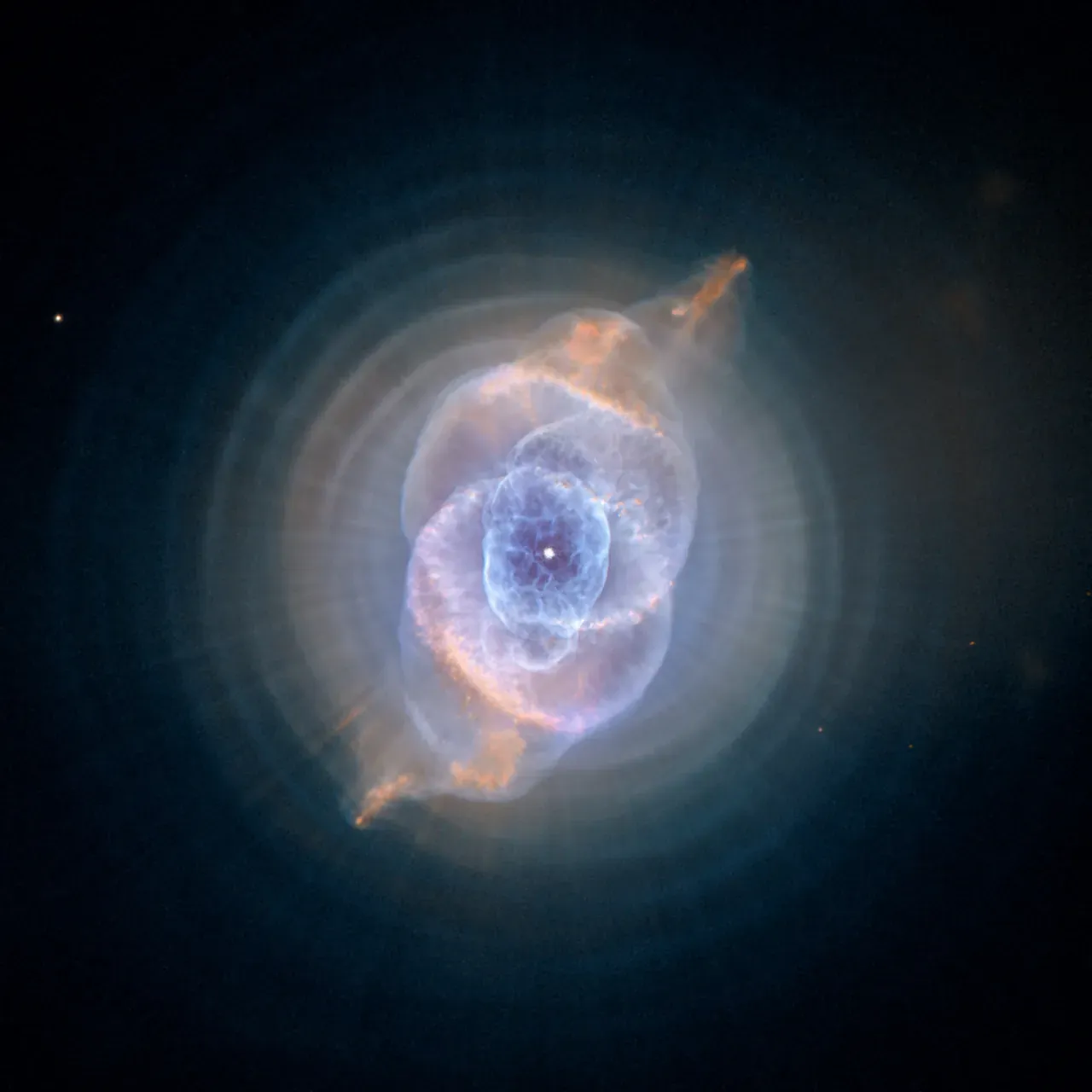
The Cat's Eye
The planetary nebula NGC 6543: shells of gas cast off by a dying star, 3,000 light-years away. The Hubble image is assembled from the light of narrow spectral lines of oxygen, hydrogen and nitrogen. A notable share of that light is "forbidden" lines: in dense earthly gas such a transition is quenched by collisions, while in the thin nebula an excited atom waits tens of seconds — and radiates. For six decades these lines were ascribed to an unknown element, "nebulium", until quantum selection rules explained them as oxygen.
Selection rules worked out in earthly laboratories shine in the sky thousands of light-years away.
Two disciplines of refusal
The strength of both is refusal. Physics knows the quantum world with a precision no theory before it has known — and refuses to draw in "how it really is" where the theory gives no picture: not "through the left", not "through the right", and not "we simply failed to peek". has for a thousand years affirmed God's attributes as real — and refuses to ascribe modality to them: bila kayf, without "how". Two exact knowledges — and each knows how to stop at its boundary.
This is a likeness of disciplines, not of subject matter: the quantum belongs to the created world, bila kayf concerns the Creator; the two refusals share no object. And the refusals differ at root: the quantum has no definite value at all, whereas the attribute is real and firm — only its modality, the created "how", is hidden. And there is a second, quieter echo — with the argument from : alternatives do not decide themselves; the actual cannot be read off from the possible. Quantum theory, in its own voice and about its own subject, says something structurally akin: there are no ready-made values "inside". These are different theses of different disciplines — but their grammar is kindred, and to hear that kinship is precisely .
from the kalam
الاِسْتِوَاءُ غَيْرُ مَجْهُولٍ، وَالْكَيْفُ غَيْرُ مَعْقُولٍ، وَالْإِيمَانُ بِهِ وَاجِبٌ، وَالسُّؤَالُ عَنْهُ بِدْعَةٌ
The rising is not unknown; the "how" is not grasped by reason; belief in it is obligatory; asking about it is an innovation.
وَيَسْأَلُونَكَ عَنِ الرُّوحِ ۖ قُلِ الرُّوحُ مِنْ أَمْرِ رَبِّي وَمَا أُوتِيتُم مِّنَ الْعِلْمِ إِلَّا قَلِيلًا
They ask you about the spirit. Say: "The spirit is of the command of my Lord." And you have been given of knowledge only a little.