'Ilm · al-Batin
The Hidden
The horizon of created knowledge — and the One who knows every hidden thing
What does a place look like from which even light does not return?
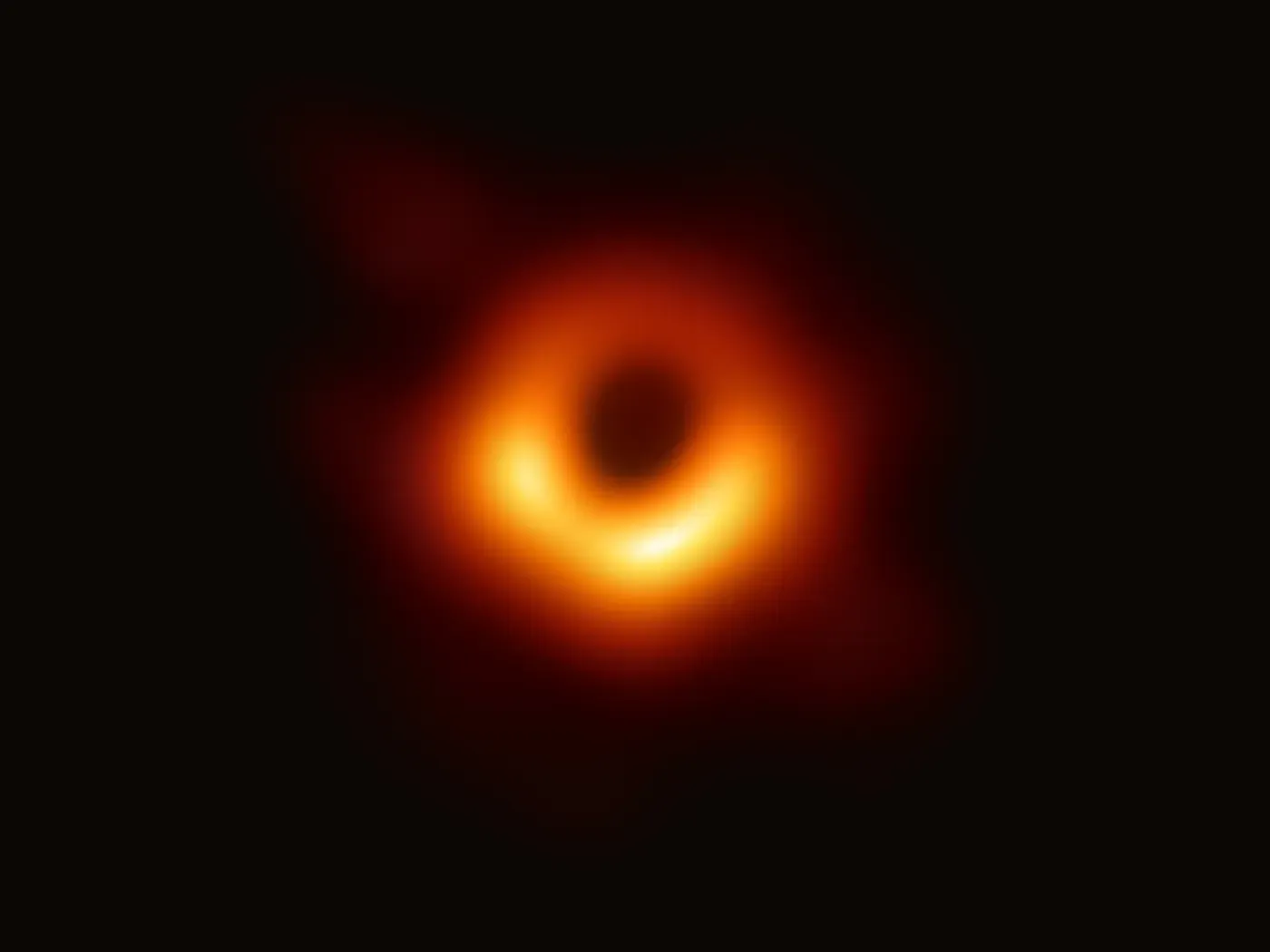
The shadow of M87*
The first image of a black hole's shadow: the Event Horizon Telescope, 2019. The galaxy M87, 55 million light-years away; the mass — about six and a half billion suns. The glow is hot gas. The dark patch is the region from which light does not reach us.
What we are seeing
The ring in the image is the light of hot gas. Gravity bent it so strongly that some rays wrapped around the black hole before escaping toward us. The dark patch is the "shadow": the region from which light does not reach the observer. Inside it lies the event horizon — the boundary of no return. This is not a drawing and not a simulation. It is a radio image assembled by a network of telescopes the size of a planet.
You have already seen gravity bend light: in the Hall of Space it stretched a galaxy into an arc. Here it is pushed to the limit — light is closed into a ring.
A star around the invisible
This image has a younger counterpart in our own Galaxy. At its center, behind a veil of dust, the star S2 races along an elongated orbit around a point where nothing is to be seen. One revolution: sixteen years. At its nearest point — about seventeen light-hours from the center; its speed — about 7,700 kilometers per second, two and a half percent of the speed of light. For a quarter of a century telescopes tracked its path, loop by loop, like a planet.
From the laws of motion came the mass of the invisible point: about four million suns — within a region smaller than the star's own orbit. No known alternative explains these data as convincingly as a black hole. For this tracking, the Nobel Prize of 2020 was awarded. And the result is restrained: no one here saw the black hole itself. They saw its gravity — in the motion of the star.
Where observation ends
Beyond this point theory begins, and we mark that honestly. The evaporation of black holes — Hawking radiation — has never been observed from real black holes: the effect is too faint. Only laboratory analogues have been observed. What happens to information that falls behind the horizon is an open problem. Physicists have argued over it for decades.
At the limit of the most extreme object in the Universe, physics itself admits: it does not know — how. The discipline of such not-knowing the tradition calls .
…لِتَعْلَمُوا أَنَّ اللَّهَ عَلَىٰ كُلِّ شَيْءٍ قَدِيرٌ وَأَنَّ اللَّهَ قَدْ أَحَاطَ بِكُلِّ شَيْءٍ عِلْمًا
…that you may know that Allah is powerful over all things and that Allah encompasses all things in knowledge.
هُوَ الْأَوَّلُ وَالْآخِرُ وَالظَّاهِرُ وَالْبَاطِنُ، وَهُوَ بِكُلِّ شَيْءٍ عَلِيمٌ
He is the First and the Last, the Manifest and the Hidden; and He is, of all things, Knowing.
The horizon of knowledge
That dark patch in the image is the event horizon, an honest boundary of created knowledge: from beyond it returns neither light nor tidings, and what lies within, theory disputes to this day. A black hole is the most hidden thing creation has. Yet nothing hidden is hidden from the Hidden: al-Batin is veiled not by a horizon or by distance, but by transcending all grasp. For Him there is no "beyond the horizon" — what is hidden from every gaze is not hidden from the One who knows not by observation.
And about the limit. A black hole does not prove omniscience: the horizon is a fact of geometry, omniscience is a tenet of faith; the floors are different. Two limits merely stand together: the limit against which created knowledge has run — and the Knowledge that has no limits. This is — an occasion for contemplation.