A sign · tanzih
The Tremor of Space
A hundred years from a prediction on paper to a tremor finer than a proton
Can one catch the tremor of space itself?
خَلَقَ الْخَلْقَ بِعِلْمِهِ
He created creation by His knowledge.
Whose sky we are listening to
Al-Tahawi's speaks of the Creator, not of detectors: He created creation by His knowledge. And everything that trembles is created: the very geometry that contracts and stretches is as much a creature as a stone or a ray of light. Listening to the sky, we listen to creation.
And this is the purest sky on the path: the greatest astonishment. In the Hall of Space it was already said: Allah was — and there was no place. The tremor of space is no "closer to Him" than silence: it too is creation, only heard for the first time.
A ripple of geometry
In 1916 a strange consequence emerged from Einstein's equations. When enormous masses accelerate, it is not matter that trembles — it is geometry itself. Space contracts and stretches almost imperceptibly, and this ripple runs at the speed of light. For nearly a century no one could catch it: by the time it reaches the Earth it is unimaginably faint.
First came indirect evidence. The Hulse–Taylor binary — a pulsar and a second neutron star — drew together over decades at exactly the rate it should if the energy is carried off by waves of space. This earned the Nobel Prize of 1993. But the ripple itself still no one had "held in their hands".
The fourteenth of September
On 14 September 2015 two LIGO detectors in the United States — three thousand kilometers apart — quivered with one and the same burst, seven milliseconds apart. The burst's signature matched the calculated one: more than a billion light-years from us, two black holes had merged, of about thirty-six and twenty-nine solar masses.
Their masses sum to about sixty-two, not sixty-five. Three solar masses turned, in fractions of a second, into a ripple of space. At its peak the merger radiated more power than all the light of all the stars of the observable Universe. And what reached the Earth was a tremor of mere thousandths of a proton's diameter — that is what was caught. The Nobel Prize of 2017; today the catalogs hold hundreds of such events.
A sky one can listen to
The frequency of this ripple is tens and hundreds of oscillations per second: the range of human hearing. So a detector's recording can honestly be turned into sound. The result is a short rising whistle — physicists call it a "chirp", the cheep of a bird. This is no special effect: this is how the data themselves sound, as a voice sounds from the groove of a record.
And yet a gravitational wave is not sound. Sound needs air, and this tremor travels through the void, because it is geometry itself that trembles. But astronomy gained a powerful new channel unconnected with light. Almost all astronomical knowledge of the sky before 2015 — from radio waves to gamma rays — was brought by light. Now the sky has a second language.
Light and wave arrived together
August 2017: the detectors caught the merger of two neutron stars, and 1.7 seconds later satellites saw a gamma-ray burst from the same region of the sky. Both signals had traveled toward us for 130 million years — and arrived almost abreast. So the ripple of space runs at the speed of light: a divergence of speeds is ruled out to the fifteenth decimal place.
Then dozens of observatories watched for weeks the fading flare — a kilonova. In its spectrum freshly created heavy elements were read: strontium identified directly from its lines. Calculations make such collisions one of the chief sources of gold and platinum in the Universe. So began "multi-messenger" astronomy: a single event, read both by wave and by light.
A point that was not there
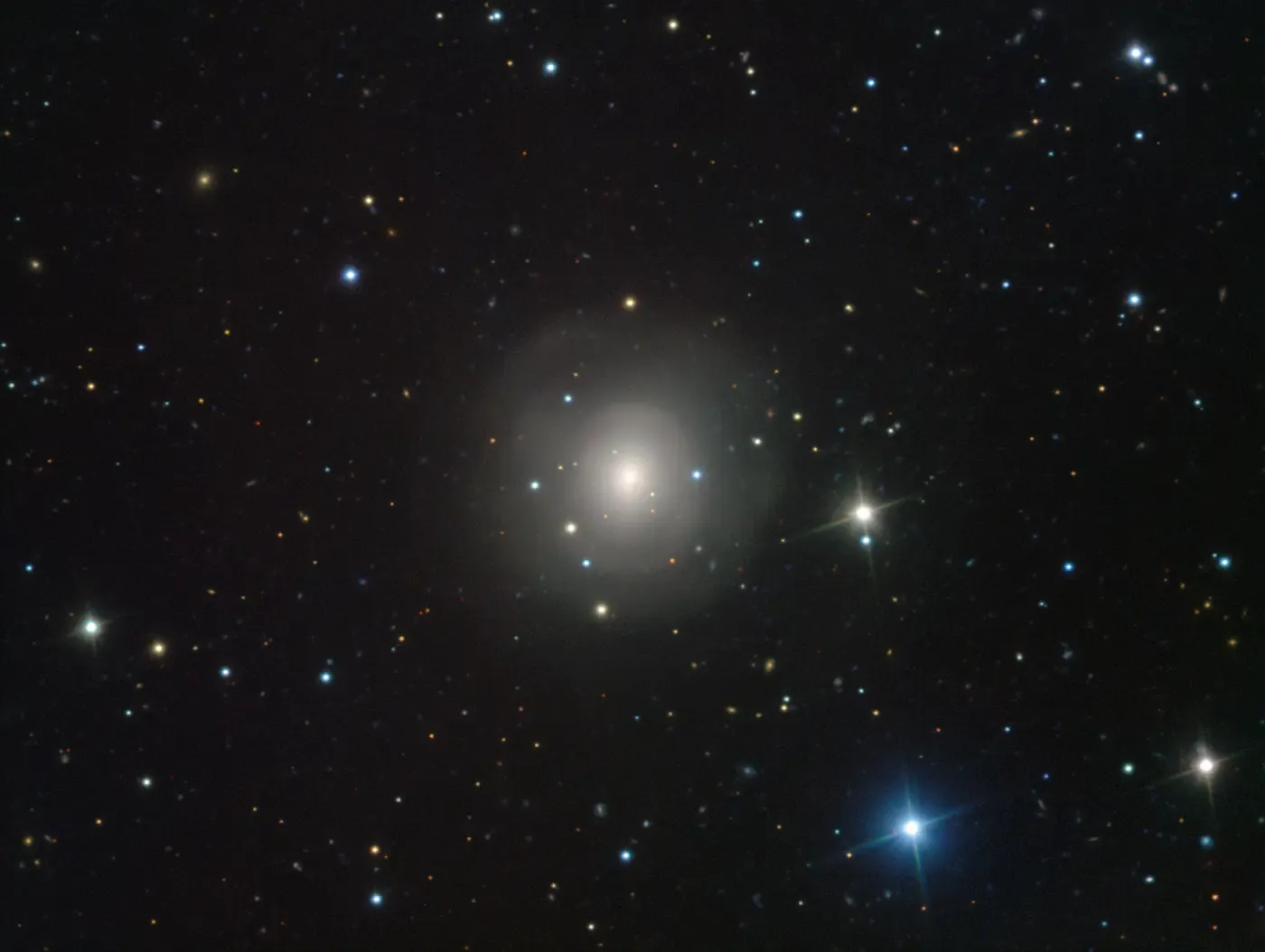
The galaxy NGC 4993 — an image from the VLT telescope (ESO), taken within days of the burst. Just above and to the left of the nucleus is a new point of light: the kilonova. The galaxy itself is in no way remarkable; in images from earlier years this point is absent.
It was no guess that drew the eye here, but the tremor of space: the wave pointed to the place, the light confirmed it.
وَقَدَّرَ لَهُمْ أَقْدَارًا، وَضَرَبَ لَهُمْ آجَالًا
…and He ordained for them measures, and appointed for them terms.
A new sense
The line of the matn that opened the hall is here spoken to its end: He created by His knowledge — and appointed the terms. For two neutron stars the term came due a hundred and thirty million years ago; the tidings of it — ripple and light — reached us only now.
A century ago humanity had one channel to the sky — light; now there are two. But it was not knowledge of the Creator that increased — it was the signs: the world, read with one more sense, proved denser with pointers to the One who resembles none of them. This step does not exalt itself above the earlier ones and opens no new argument — it shows one thing alone: how astonishment grows when it does not pretend to be proof.