Irada · will and takhsis
Fine-Tuning
: from the possible, the actual was chosen
The world could have been otherwise. Why is it this way?
وَكُلُّ شَيْءٍ يَجْرِي بِتَقْدِيرِهِ وَمَشِيئَتِهِ، وَمَشِيئَتُهُ تَنْفُذُ
All things proceed by His determination and His will; and His will comes to pass.
A world by will
The creed speaks of the world in the language of will: all that exists, exists by the Creator's knowledge, His determination — taqdir — and His will. "And nothing comes to be except what He wills," al-Tahawi set down. That will is free: God is not compelled to create — nor compelled to create just so.
From this follows a quiet but enormous thought: the world could have been otherwise. Actuality is not necessity — it is something chosen.
Numbers that follow from nothing
At the foundation of physics lies a set of constants: the speed of light, Planck's constant, the masses of particles, the strengths of interactions. The most telling are dimensionless — like the fine-structure constant α ≈ 0.0072973525693: a pure number, depending on neither meters nor seconds. It sets the strength of the electromagnetic interaction, and such numbers are not derived from the theory itself — they are learned only by measurement.
Richard Feynman — one of the creators of quantum electrodynamics — called α "a magic number that comes to us with no understanding". The Standard Model has about two dozen such free parameters that the theory does not predict, and cosmology adds its own. They are measured superbly — but to the question "why precisely these?" physics has no answer. The equations take these numbers as given.
Universes on paper
Physicists know how to compute worlds that do not exist: keep the equations, shift one number — and trace the consequences. Make α markedly different — and the sizes of atoms, all of chemistry, the very burning of stars would drift. A slightly different nuclear force — and stars would not forge carbon: its synthesis hangs on a delicate resonance that Fred Hoyle predicted in advance, from the very fact that carbon exists. A slightly larger cosmological constant — and matter would fly apart before gathering into galaxies.
But here is the essential point: such universes exist only on paper. The calculation turns a single number, silently assuming this is "allowed" — yet which worlds are genuinely possible is beyond the reach of observation. An honest exercise of thought, nothing more.
"One chance in 10⁶⁰"
At this point a number usually appears: "the probability of such a set of constants is one chance in ten to an enormous power". But on its own it means nothing. To speak of probability one needs a measure — a way to weigh imaginary universes against one another. There is none, and it is unclear where one would come from: we have a single Universe, and nowhere to watch the "draw". Without a measure, a "narrow" permitted range cannot be told from a "wide" one — the tuning may turn out far less fine than it looks.
Among philosophers of physics this dispute is alive: some hold that a measure can be made sense of, others that the project is hopeless; it is not settled. So the argument "from improbability" is not needed: , as will now become clear, does without it.
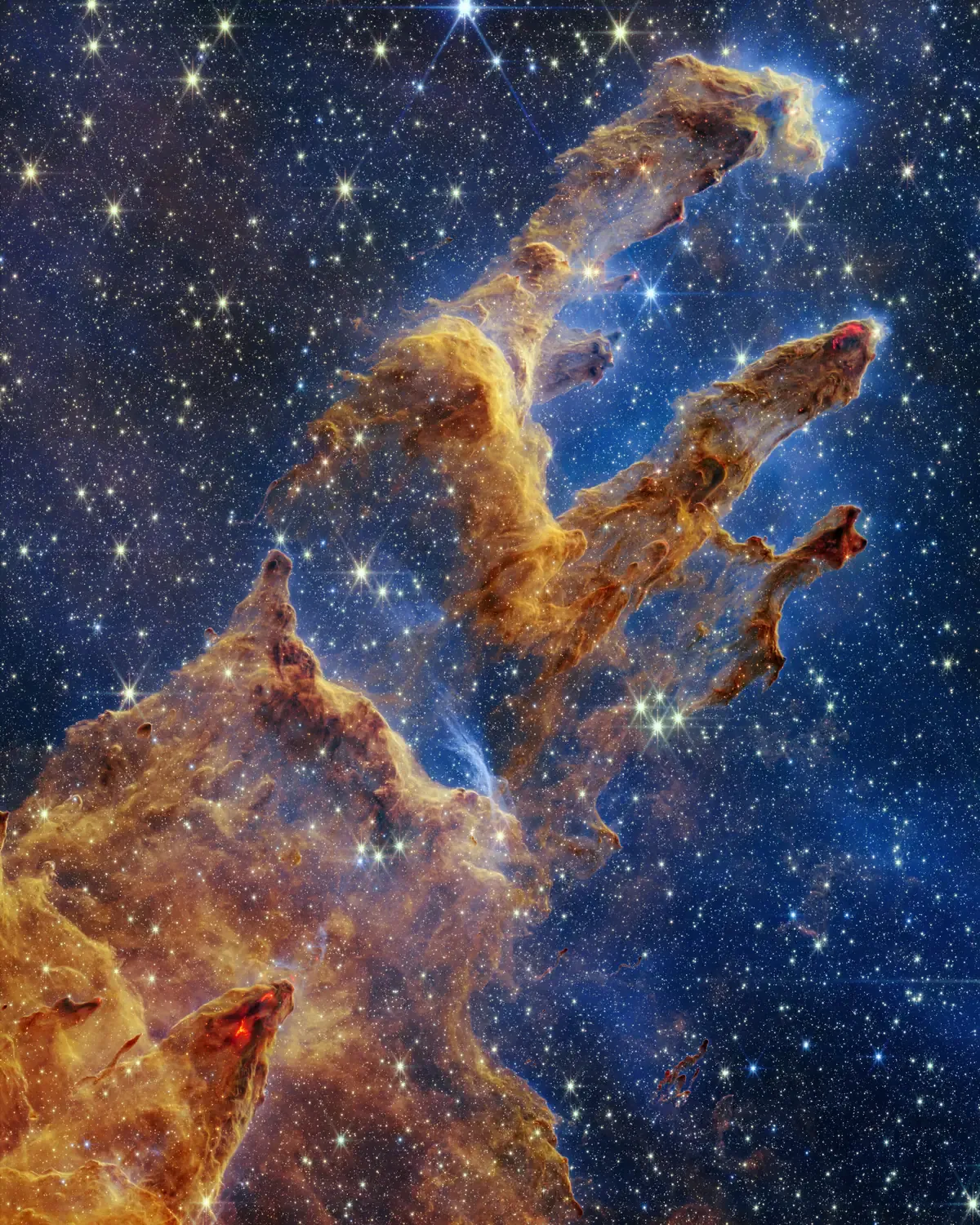
The Pillars of Creation
Pillars of cold gas and dust in the Eagle Nebula, 6,500 light-years away — a stellar nursery. Webb's infrared camera sees through the dust: the red knots at the pillars' tips are stars being born.
Every star in this frame burns at those very values of the constants.
The argument of choosing
From here kalam builds an argument of a different kind — takhsis, the argument of determination to one. If the world's foundation admitted alternatives equally — and nothing within the world explains why precisely this one came to be — then its very determination to be this one requires a Determiner: a free will choosing one out of the equally possible. Al-Baqillani unfolded this move, al-Juwayni gave it strict form, al-Ghazali put it to work in his dispute with the philosophers.
The argument has two properties for which we chose it. It needs no experience: neither probability, nor measure, nor "one chance in 10⁶⁰" — the bare possibility of otherwise, jawaz, suffices; the physics here has merely given it a vivid image. And it goes through will, not through purpose: not "the world is tuned for life", but "from the possible, the actual was chosen". And a third thing: this argument is not in al-Tahawi's — it is forged by later rational kalam; it is a reasoning of the intellect, not a line of Revelation.
from the kalam
فَإِذَا وَقَعَ الْوُجُودُ الْجَائِزُ بَدَلًا عَنِ اسْتِمْرَارِ الْعَدَمِ الْمُجَوَّزِ، قَضَتِ الْعُقُولُ بِبَدَاهَتِهَا بِافْتِقَارِهِ إِلَى مُخَصِّصٍ خَصَّصَهُ بِالْوُقُوعِ
When possible existence occurs in place of an equally admissible continuance of non-existence, minds judge with sheer self-evidence: it stands in need of a Determiner who determined it to occur.
Intra-Sunni seam
Does God create "for the sake of"?
The word "tuning" itself drags in the question of purpose: tuned — so, for something? Here the schools part ways. The Maturidis allow speaking of wisdom and purposes — hikma — in God's acts. The Ash'aris object: God's acts are not conditioned by purposes — such conditioning, , would mean need, and He needs nothing.
The takhsis argument is good precisely because it passes this seam by: it needs only a will choosing from the possible — of purposes it says nothing, and both schools can walk on with it. And the language of the perfection of creation — , the name al-Hakim, the Wise — remains what it has always been: a language of reverence common to the whole ummah. As a load-bearing argument it does not serve here.
صُنْعَ اللَّهِ الَّذِي أَتْقَنَ كُلَّ شَيْءٍ
Such is the work of Allah, Who has perfected all things.
Physics here did one thing: it showed that at its foundation lie numbers that follow from nothing — and gave an image of the world's could-have-been-otherwise. It does not establish a Chooser; takhsis does not depend on experience, and calculations of "broken universes" make it neither stronger nor weaker. Symmetrically, the opposite move too: "the multiverse explained the tuning without any will" is not an observation but a hypothesis that merely lifts the question of the laws one floor up. The plurality of worlds did not trouble kalam: ar-Razi wrote that Allah's power is not exhausted by this world — and however many worlds come to be, each needs to be chosen.