Qudra · the Creator's custom
Causality
: the world's regularity as the Creator's custom
Does fire burn — or does the Creator of fire create burning?
لَا رَادَّ لِقَضَائِهِ، وَلَا مُعَقِّبَ لِحُكْمِهِ، وَلَا غَالِبَ لِأَمْرِهِ
Nothing repels His decree, nothing overturns His judgement, nothing overcomes His command.
Creator of all things
"Allah is the Creator of all things," says the Qur'an. The creed reads these words without exemptions: creation is not a single act in the distant past, after which the world runs on its own. Whatever happens, happens by His decree and command; the adds: "Creator without need" — He requires no effort, no instrument, no intermediary.
But if so — what does the familiar "fire burns" mean? Who is acting here: the fire — or the Creator of fire? posed it in full rigour a thousand years before the philosophy of science made it its own.
from the kalam
الاِقْتِرَانُ بَيْنَ مَا يُعْتَقَدُ فِي الْعَادَةِ سَبَبًا وَمَا يُعْتَقَدُ مُسَبَّبًا لَيْسَ ضَرُورِيًّا عِنْدَنَا
The conjunction between what is customarily believed to be a cause and what is believed to be its effect is, according to us, not necessary.
Fire and cotton
By this sentence al-Ghazali opens the seventeenth discussion of the Tahafut al-falasifa — and in it lies the whole answer of Ash'ari kalam. Created things have no compelling power of their own. Fire does not "produce" burning — Allah creates the burning at the contact of fire with cotton; fire is an occasion, not the master of the effect. The West would later call this position occasionalism, from the Latin occasio — "occasion". The world's regularity, in this language, is al-'ada — the custom the Creator keeps; a miracle is , a rending of the custom: the fire did not burn Ibrahim, because that time Allah did not create the burning.
The classical school went further still: it pictured the world as a scatter of atoms and properties which Allah renews every instant — tajdid al-khalq, perpetual creation. The "atom" of kalam is indivisible by definition and does not coincide with the atom of the laboratory, and we draw no parallels to quantization from it. And a second thing: occasionalism as a theory is not in al-Tahawi's matn — the school built it over the creed; this is a reasoning of kalam, not the matn itself.
قُلْنَا يَا نَارُ كُونِي بَرْدًا وَسَلَامًا عَلَىٰ إِبْرَاهِيمَ
We said: "O fire! Be coolness and safety for Ibrahim!"
Conjoined — never connected
Six and a half centuries later the Scottish philosopher David Hume posed the same question from the other end. What do we see when "fire burns"? Contact, then burning: one after the other, always. But the connection itself — the necessity that would force the effect to follow — is nowhere in experience: "events seem conjoined, but never connected". All we are given is the constant repetition of pairs; the expectation that it will hold tomorrow Hume called a habit of the mind.
The legend that "Hume read al-Ghazali" is lovely, but no evidence supports it. What is documented is different: Hume advised preparing for his Treatise by reading Malebranche — the Cartesian occasionalist who taught that the only true cause is God. Occasionalism Hume knew first-hand, examined directly in the Enquiry Concerning Human Understanding — and rejected. Before us is neither succession nor quotation: two thinkers from different worlds ran into one and the same observation — and drew opposite conclusions from it.
What is a law of nature?
It may seem science settled this dispute long ago: there are the laws — in every textbook. But science inherited the question, not the answer. The equations of physics describe the world's regularities impeccably and predict new ones; yet about what makes a regularity regular — what the word "law" even means — the dispute in philosophy of science is alive to this day.
It has at least three camps. Hume's heirs: a law is a compact description of actual regularities, their best systematization; nothing "governs" the world. Realists about laws, like David Armstrong: a law is a genuine relation of necessitation between properties of things — that which underwrites the regularity. And sceptics of the very notion, like Bas van Fraassen: physics does not need the word "law" — symmetries and models suffice. Experiment does not choose between them: all three read the same equations. "Law of nature" is the everyday name of an unresolved metaphysical question. Kalam stood at its source.
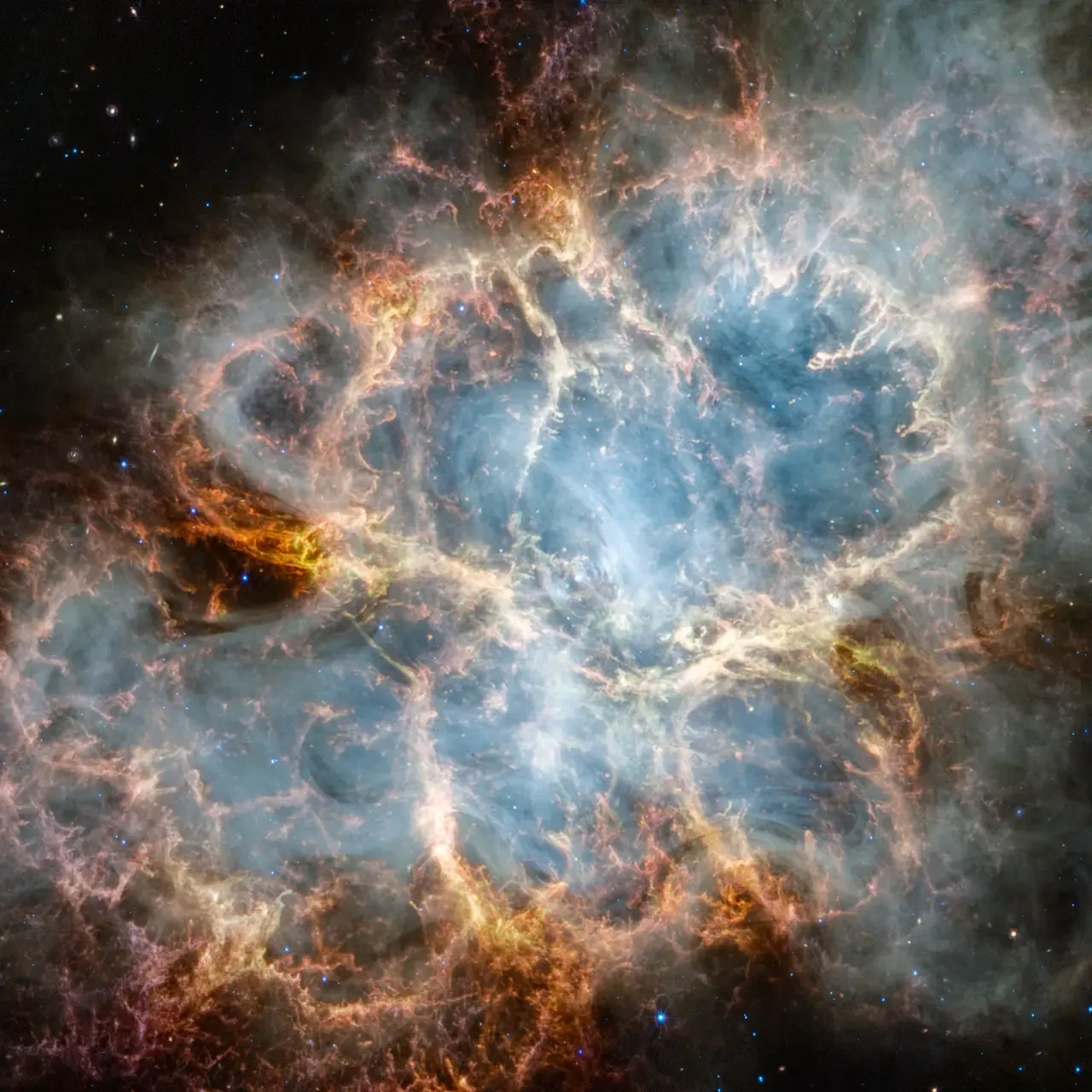
The guest of 1054
The Crab Nebula: the scattering remains of the supernova of 1054 — chroniclers of China and Japan recorded a "guest star" visible even by day. Today the cloud spans eleven light-years, 6,500 light-years from us. The milky glow inside the cage of gas filaments is synchrotron radiation, fed by the pulsar at the centre of the frame — a lighthouse star spinning thirty times a second.
A thousand years of a single causal history: a flash set down by chroniclers — and a cloud we caught mid-flight.
The furnaces of the elements
This nebula has a sequel — in you. The light nuclei the Universe received in its first minutes: hydrogen, helium, traces of lithium. Almost everything else was cooked in stars. The carbon of your body and the oxygen of your breath were assembled in stellar interiors. The iron of your blood was finished and scattered by a supernova — a flash like the "guest" of 1054; the calcium of your bones comes from there too. And gold — you read of this in the Hall of Gravitational Waves — comes from the mergers of neutron stars.
This is not poetry — it is an inventory. Spectra read like shipping manifests: which nuclei, how many, where they scattered. The very same elemental lines glow in the laboratory, in the Crab, and in galaxies billions of light-years away: a single hand across the whole Universe. To a discussion of custom this is fitting. The regularity al-Ghazali and Hume disputed holds from your blood to the edge of the observable world.
وَفِي الْأَرْضِ آيَاتٌ لِّلْمُوقِنِينَ، وَفِي أَنفُسِكُمْ ۚ أَفَلَا تُبْصِرُونَ
And on the earth are signs for those who are certain — and in yourselves. Do you not then see?
One observation — two conclusions
The theses, face to face. Al-Ghazali: the connection of cause and effect is not necessary — all that is observed is one thing accompanying another. Hume: no connection is found in experience — only constant conjunction, and no necessity in sight. It is one and the same epistemic thesis — "necessary connection cannot be observed" — stated six and a half centuries before Hume. A thesis about knowing, not about physics: revising the equations does not topple it — no equation shows "", only order. Even the hall of the Quantum World spoke more cautiously: the correlation of entangled pairs is real and measured, yet no simple local scenario of pre-recorded properties explains it. Conjoined, not connected: here physics has said it of its own subject.
And now the turn: the conclusions drawn from the shared observation are opposite to the point of mirroring. Al-Ghazali: since created causes do not compel, every event is created directly by God — the only true Cause. Hume: since necessity is nowhere seen, it is a habit of the mind; and that scepticism cuts every metaphysical causality, the First Cause included. From one observation, one walked to the strictest theism, the other to the strictest scepticism. So we will not say "philosophy has come round to al-Ghazali": the kinship here is in the question, not in the answer.
Intra-Sunni seam
Does God create through causes?
Within Sunni kalam the answer to "how does God create events" is not single. The Ash'ari line is occasionalism: the created has no causal efficacy of its own, no ta'thir; "causes" are occasions at which God creates, and their order is His custom. The Maturidi line is gentler toward causes: one may say that God creates things with their properties and powers — and acts through them as He wills. What the schools share matters more than what divides them: nothing acts independently of Allah, and He is free to rend the custom — miracle is possible.
The historians of philosophy add a refinement. Al-Ghazali himself is not as clear-cut as his textbook image: Frank Griffel — and with him Dominik Perler and Ulrich Rudolph — showed that in al-Ghazali's texts both models remain admissible: direct creation of every event, and action through causes which God created and sustains. He never declared a choice between them — both preserved what mattered to him: the Creator's omnipotence and the possibility of miracle. The border "al-Ghazali the occasionalist, full stop" was drawn harder by later retellings than by the man himself.
وَخَلَقَ كُلَّ شَيْءٍ فَقَدَّرَهُ تَقْدِيرًا
…and He created all things and measured them with a measure.