Tanzih · not in place
Space
: the created does not contain the Creator
Does the Universe have a center — and can one ask "where" about its Creator?
وَتَعَالَى عَنِ الْحُدُودِ وَالْغَايَاتِ وَالْأَرْكَانِ وَالْأَعْضَاءِ وَالْأَدَوَاتِ، لَا تَحْوِيهِ الْجِهَاتُ السِّتُّ كَسَائِرِ الْمُبْتَدَعَاتِ
He is exalted beyond limits and ends, beyond pillars, organs and instruments. The six directions do not contain Him — as they contain all created things.
from the kalam
وَالْجِهَاتُ وَالْأَمْكِنَةُ مِنْ أَجْزَاءِ الْعَالَمِ، وَهُوَ مُسْتَغْنٍ عَنِ الْعَالَمِ وَأَجْزَائِهِ؛ لِأَنَّ الْجِهَاتِ السِّتَّ مُحْدَثَةٌ، وَهِيَ أَوْصَافٌ لِلْعَالَمِ الْمُحْدَثِ، وَاللَّهُ قَدِيمٌ
Directions and places are parts of the world, and He has no need of the world or its parts. For the six directions are originated: they are properties of the originated world. But Allah is eternal.
Tanzih
This was set down in the 10th century — a thousand years before non-Euclidean geometry. "Up", "down" and the other directions are properties of the created world; the Creator is not described by them. Tanzih — Arabic for "purification" — is a discipline of refusal: not to imagine God as a part of the world, not to assign Him a coordinate.
The question "where?" has meaning only inside space. Tanzih says: it does not apply to the Creator of space — not because the answer is hidden, but because there is nothing to ask.
from the kalam
كَانَ اللَّهُ تَعَالَى وَلَا مَكَانَ قَبْلَ أَنْ يَخْلُقَ الْخَلْقَ، وَكَانَ اللَّهُ تَعَالَى وَلَمْ يَكُنْ أَيْنَ وَلَا خَلْقٌ وَلَا شَيْءٌ، وَهُوَ خَالِقُ كُلِّ شَيْءٍ
Allah was — and there was no place, before He created creation. He was — and there was no "where", no creation, no thing at all. And He is the Creator of all things.
Space is not a stage
A century of observations has changed the very notion of "where". In general relativity, space is not a motionless stage. It is a dynamic fabric: mass curves it, and it expands. Distant galaxies recede not "through" the cosmos — the distances themselves stretch between them. And the Big Bang was not an explosion in some place, but an expansion of all distances at once.
So where is the center of the expansion? Nowhere — and everywhere. No point is privileged: every observer, wherever they stand, sees recession all around. This agrees with the map of the relic radiation and with the distribution of galaxies. The question "where is the center of the Big Bang?" asks after something that isn't there.
And is there an "edge"?
An "edge" and an "outside" are a different matter. Whether the Universe is finite or infinite, closed or flat — observations have not yet settled. The absence of a center is a firm result; no standard model has an edge — even a closed, finite Universe does without one.
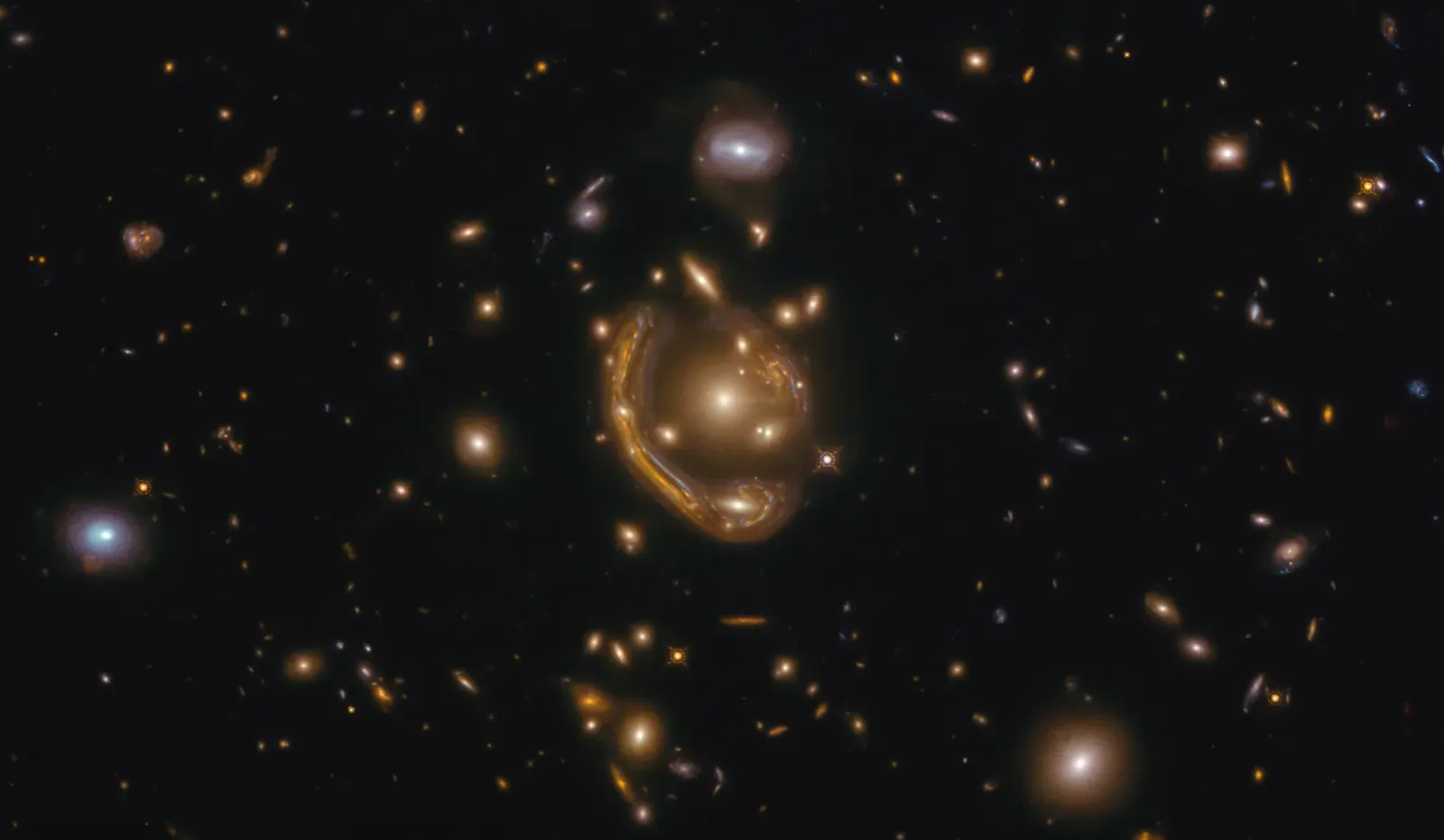
An Einstein ring
The light of a distant galaxy stretched into a nearly complete ring: it was bent by the gravity of a galaxy cluster in the foreground. The curvature of space is not a metaphor: it is right there in a Hubble photograph.
Where the question loses its meaning
Two answers rhyme. To the question "where is the center of the Universe?" the physicist replies: the question has no object — the expansion has no center. To the question "where is God?" the scholar of replies: the question has no object — directions are created, and the Creator is not contained by them. It is like asking what lies north of the North Pole.
It is a consonance of two disciplines of thought: both dismiss the question itself — and both show why. Each holds to its own foundations and follows its own path. To hear this encounter — without merging the paths — is , the contemplator's lesson.
مُحِيطٌ بِكُلِّ شَيْءٍ وَفَوْقَهُ، وَقَدْ أَعْجَزَ عَنِ الْإِحَاطَةِ خَلْقَهُ
He encompasses all things and is above them; and He has rendered His creation incapable of encompassing Him.
The expansion of the Universe does not prove that the world is created: kalam's argument from origination — — stands on reason alone, and the Big Bang makes it neither stronger nor weaker. The reverse holds too: the scientific picture will yet be revised — tanzih does not stand on physics. It has merely given us an occasion to contemplate it.